What resonance really is: from playground swings to singing bowls
Evidence label: Well studied
The label refers to the physics explained here. The box on wellness claims near the end discusses claims that are not supported by that physics.
In short
- What this is: Resonance happens when something that can vibrate is pushed at its own natural rhythm. Small, well-timed pushes then build up into large vibrations.
- What the evidence says: This is established physics, explained in every university textbook and measured in everything from bridges to singing bowls to the human voice.
- What it means for your practice: Your voice uses resonance all the time: the spaces of your throat and mouth shape every sound you make. That is real and audible. It is something different from the “resonance” of wellness marketing.
What science says
Everything springy has a natural frequency. A swing, a guitar string, a wine glass or a bronze bowl: if you nudge it and let go, it vibrates at a rate of its own. Physicists call this its natural frequency, the rate at which it would vibrate if nothing drove it and nothing slowed it down [1].
Resonance: the right push at the right time. Now push the system repeatedly. If your pushes come at a very different rate from its natural frequency, not much happens. If they match it, each push adds a little energy at just the right moment and the vibration grows. This is resonance [1]. The classic example is a parent pushing a child on a swing. To swing higher, the parent does not shove hard. They give small pushes at exactly the swing’s own rhythm, and the swing goes higher with each one [1].
Damping keeps things in check. Real systems lose energy, for example through friction or air resistance. This is called damping. The less damping a system has, the taller and narrower its resonance peak: it responds strongly, but only to a very precise frequency [1]. With a lot of damping, the response is weak and spread out.
Resonance in everyday life. Sing a loud note into a piano with the dampers lifted, and the strings with matching frequencies sing the note back [1]. Hospital MRI scanners use resonance of atomic nuclei driven by radio waves. And when the Millennium Footbridge in London opened, people walking across it reinforced its swaying; the bridge was closed for about two years to fix it [1].
Not every dramatic wobble is simple resonance, though. The 1940 collapse of the Tacoma Narrows Bridge is often shown in textbooks as wind matching the bridge’s natural frequency. Engineers who studied it found something different: a self-exciting interaction in which the wind forces were tightly linked to the bridge’s own twisting motion [2].
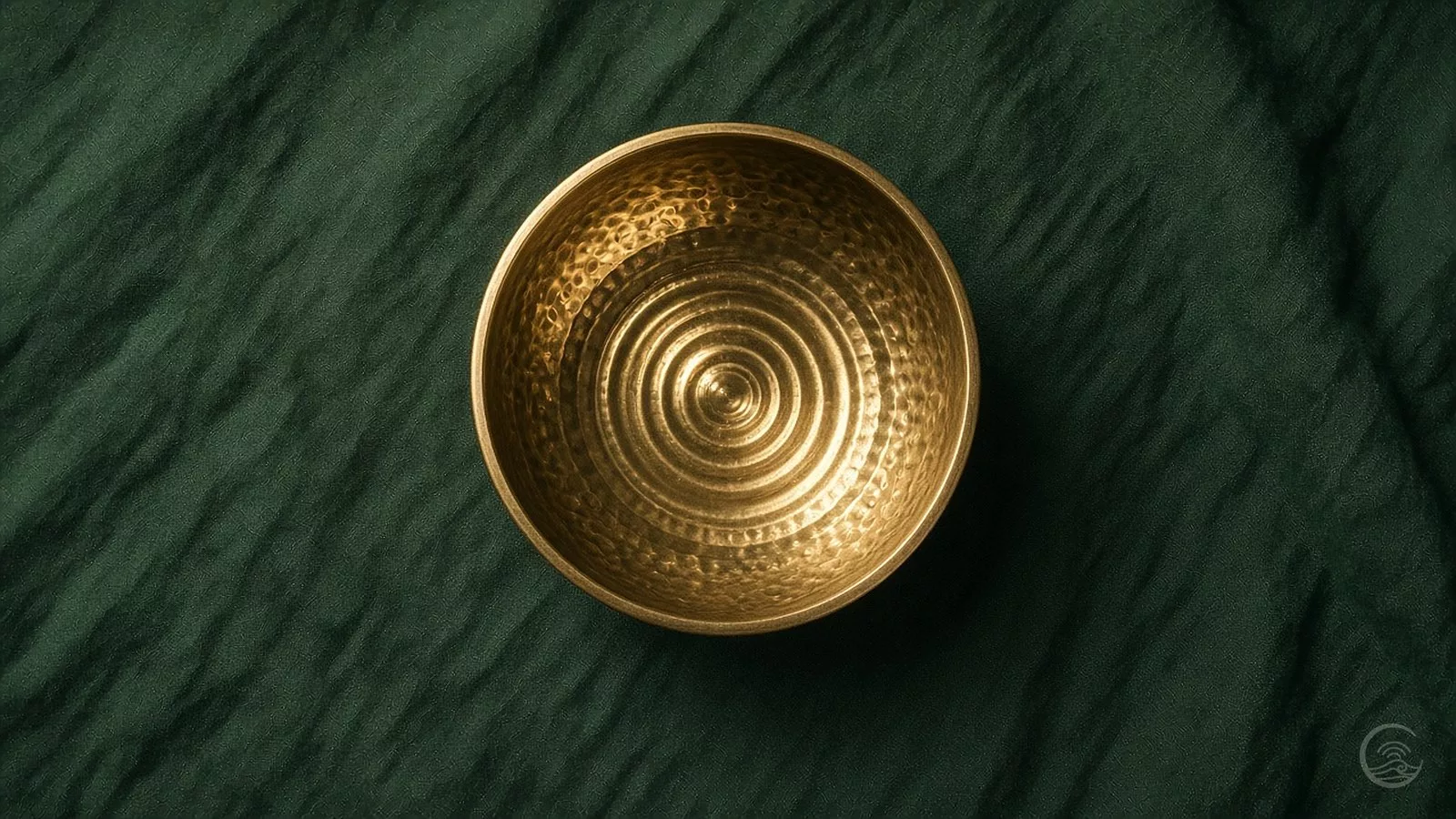
Singing bowls. A singing bowl is a kind of standing bell. Physicists Denis Terwagne and John Bush studied four antique Tibetan bowls with fundamental frequencies between 187 and 428 Hz [3]. Striking a bowl sets off several of its natural vibration patterns at once. Rubbing the rim with a leather-wrapped mallet works like a moist finger on a wine glass: a rapid stick-and-slip motion that mainly excites the lowest pattern, in which the rim flexes into a gentle oval. Thicker walls raise the pitch, a larger radius lowers it, and adding water lowers it too. Small irregularities in a hand-made bowl split one tone into two very close ones, which you hear as a slow beating. Fill a bowl with water and drive it hard enough, and ripples turn into standing wave patterns and finally throw droplets into the air [3].
Standing waves and your voice. In a string, a pipe or a bowl, resonances go hand in hand with standing waves: vibration patterns that stay in place instead of travelling. Your vocal tract, the space from the vocal folds to the lips, is a tube about 15 to 20 cm long, and it has resonances too [4]. The vocal folds produce a buzzing sound full of frequencies, which mainly sets the pitch. The vocal tract then strengthens some frequencies and weakens others, depending on the position of your tongue, jaw and lips. The resulting peaks in the sound are called formants, and they are what makes an “ee” sound different from an “oo” [4]. For spoken vowels, the first resonance usually lies between about 200 and 800 Hz and the second between about 800 and 2,000 Hz [4]. Sopranos even adjust their mouth opening so that the first resonance follows the note they are singing, which makes high notes louder for the same effort [4].
How strong is this evidence? The physics of resonance is established textbook material, tested in countless measurements. That is why this article carries the Well studied label. Voice science is an active research field and some details are still debated, but the basic picture of the vocal tract as a resonator is not in doubt [4].
Where popular claims go beyond the evidence
When wellness marketing says resonance, it usually means something else. This box is about claims, not about physics. Claims like those below would be labelled Speculative.
- “This sound resonates with your liver.” Physical resonance needs a driving frequency that matches a natural frequency of a particular structure, and it needs a way for the energy to get there. Soft, water-rich body tissue is heavily damped. We know of no measurements showing that a given vocal sound drives a given organ into resonance. In Liu Zi Jue, the pairings of sounds and organs have changed several times over its history, which points to a traditional system of thought rather than an acoustic effect.
- “Everything has a frequency, so the right frequency restores balance.” Objects do have natural frequencies, but the body has no single “frequency” that a tone could correct.
- “Resonance” as a metaphor. Saying an idea “resonates with you” is fine as everyday language. It is simply not physics.
- Morphic resonance. Despite its name, this hypothesis is not about physical resonance at all; we may look at it in a future article.
Claims like these are sometimes wrapped in quantum language as well. For what physicists actually mean by “observation”, see “Quantum healing” and the observer effect: what physicists actually mean; for why your body, although its molecules obey quantum mechanics, behaves classically as a whole, see Quantum biology: what’s real, and why your body isn’t a quantum computer.
What remains is real and worth enjoying: when you sing, hum or voice a sound, the vibration is physical and you can feel it. Place your fingers on your throat while speaking loudly and you will notice it [4].
How this relates to the Six Healing Sounds, Qigong and neigong
Label for this section: Well studied (vocal-tract acoustics and resonance-frequency breathing) · Tradition only (Qigong and neigong concepts) · Speculative (claims that a sound resonates with an organ or with qi).
Each of the six sounds is a different shape of your vocal tract, and so a different set of resonances [4]. That is why xu, he or chui sound and feel different in the mouth and throat. This is the solid, physical side of working with sound.
There is a second, quieter link. Your heart rate and blood pressure are steadied by a feedback loop with its own natural rhythm of about one cycle every ten seconds. Breathing slowly at about that pace drives it into resonance, which is the idea behind “resonance frequency breathing” [5]. Long, slow exhalations on a sound are one way to come close to that pace, as our article Slow breathing and heart rate variability explains.
In Qigong and neigong, “resonance” is sometimes used for the feeling of a sound spreading through the chest or belly, or for a sense that qi responds to breath and attention. The first part has a physical basis: the vibration of your voice does travel through your body, and you can feel it [4]. The idea that a particular sound makes a particular organ, or your qi, resonate is traditional theory or metaphor, not measured physics, as the box above explains.
Resonance Heritage Qi is a personal, music-assisted practice inspired by Liu Zi Jue: connected to it, not a replacement for the traditional form or for study with a teacher of that tradition. We use “resonance” in its physical, audible sense, and where we use it as a metaphor, we say so.
Try it gently (optional)
- Sit comfortably and rest your fingertips lightly on your throat.
- Breathe in through your nose, then breathe out on a soft, voiced “aaa”. Feel the vibration under your fingers.
- Keep the same pitch and slowly change the vowel to “ooo” and then “eee”. Notice how the sound changes colour while the pitch stays the same: that is your vocal tract’s resonances shifting.
- Rest with a few quiet breaths. Never force your voice or breath; stop if anything feels strained.
Enjoyed this article? Get my free practice guide to the Six Healing Sounds. Just sign up below, confirm your email, and it’s on its way.
Sources
- Ling SJ, Sanny J, Moebs W, 2016. University Physics Volume 1, section 15.6: Forced oscillations. OpenStax, Rice University. https://openstax.org/books/university-physics-volume-1/pages/15-6-forced-oscillations
- Billah KY, Scanlan RH, 1991. Resonance, Tacoma Narrows bridge failure, and undergraduate physics textbooks. American Journal of Physics 59(2):118–124. https://doi.org/10.1119/1.16590
- Terwagne D, Bush JWM, 2011. Tibetan singing bowls. Nonlinearity 24(8):R51–R66. https://doi.org/10.1088/0951-7715/24/8/R01 (open preprint: https://arxiv.org/abs/1106.6348)
- Wolfe J, Garnier M, Smith J. Voice acoustics: an introduction. Acoustics Group, University of New South Wales (UNSW), Sydney, accessed 18 October 2026. https://newt.phys.unsw.edu.au/jw/voice.html
- Lehrer PM, Gevirtz R, 2014. Heart rate variability biofeedback: how and why does it work? Frontiers in Psychology 5:756. https://doi.org/10.3389/fpsyg.2014.00756
Source quality note: [1] is a peer-reviewed open university textbook. [2] and [3] are peer-reviewed physics papers. [4] is an educational overview by an active university voice-acoustics research group, with references to the primary literature (including the work of Johan Sundberg). [5] is a narrative review by researchers who developed resonance frequency breathing. No source here supports the wellness claims discussed in the box.
Disclaimer
This article is for general education only. It is not medical advice and does not replace diagnosis or treatment by a doctor or other qualified health professional. Qigong and the Six Healing Sounds are traditional practices; we make no claims that they cure, treat or prevent any illness. If you have a health condition, are pregnant, or are unsure whether a practice suits you, please talk to your doctor first.