Quantum entanglement explained, without the mysticism
Evidence label: Well studied (physics)
Evidence label: Speculative (popular claims)
“Well studied” refers to the physics of entanglement, which has been tested in many experiments. The box on popular claims, and any link to practice, is labelled separately.
In short
- What this is: Entanglement means that two particles share one joint quantum state. When you measure both, their results are correlated more strongly than any “pre-agreed plan” could explain.
- What the evidence says: This is among the best-tested predictions in physics. It earned the 2022 Nobel Prize in Physics. The same physics also shows that entanglement cannot be used to send messages, energy or influence.
- What it means for your practice: Nothing medical and nothing mystical. Entanglement is a fascinating fact about tiny, carefully isolated systems. Our practice makes no quantum claims.
What science says
Label for this section: Well studied.
A pair of gloves, and why entanglement is stranger. Imagine someone puts one glove of a pair into each of two boxes and sends one box to Amsterdam and one to Tokyo. Open your box, find a left glove, and you instantly know the other one is right. Nothing travelled; the answer was fixed from the start. Entangled particles look similar at first: measure the spin or polarisation of one, and you can predict the result for its partner. The difference only shows up when you compare many measurements made along different directions.
Bell’s test. In 1964, the physicist John Bell showed that if the results were fixed in advance, like the gloves, and nothing could travel faster than light between the two sides, then the correlations would have to stay below a certain limit, now called a Bell inequality. Quantum mechanics predicts that entangled particles can go beyond that limit [1]. This turned a philosophical argument between Einstein and Bohr into something you could test in a lab.
The experiments. John Clauser and Stuart Freedman ran the first such test with entangled photons in 1972. Alain Aspect’s team in the early 1980s switched the measurement settings while the photons were in flight, so that no signal could travel between the two sides in time. Anton Zeilinger’s group later carried out some of the first demonstrations of quantum teleportation (1997) and of entanglement swapping. All found the quantum prediction, and the three shared the 2022 Nobel Prize [1].
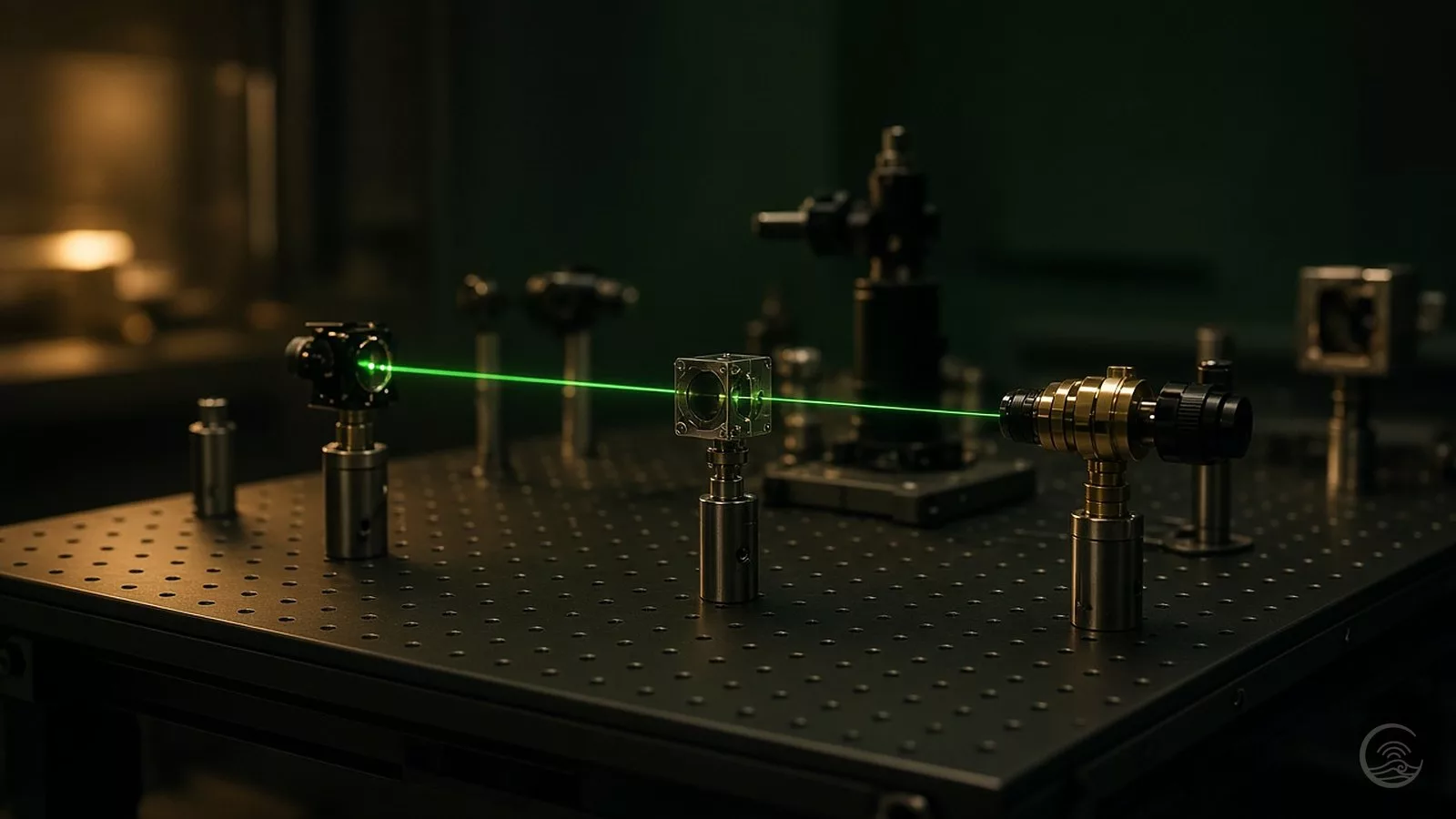
Early experiments left “loopholes”, such as detectors that missed many photons. In 2015, a team in Delft closed the main loopholes at the same time, using electron spins in two labs 1.3 kilometres apart; the Bell inequality was still violated [2]. Between 2015 and 2017, four groups in total, one of them led by Zeilinger, closed both main loopholes at once [1]. In 2017, a Chinese team sent entangled photons from a satellite to two ground stations 1,203 kilometres apart and again saw the violation [3].
What it does not do: send signals. Here is the part that popular accounts often skip. Each person, on their own, sees completely random results. The correlation only appears when the two lists are brought together and compared, which needs an ordinary channel such as a phone call or an email. Physicists have shown carefully that quantum measurements cannot transmit information faster than light [4]. So entanglement cannot carry messages, energy, intentions or healing influences from one place to another.
Why it is so fragile. Entanglement survives only while the particles are shielded from their surroundings. Every stray collision with an air molecule, every bit of heat or light, entangles the system with its environment and washes out the delicate correlations. Physicists call this decoherence [5]. In one experiment, interference of large molecules (fullerenes) faded steadily as more gas was let into the apparatus, exactly as decoherence theory predicts [6]. This is why quantum experiments need vacuum chambers, extreme cold or careful isolation, and why quantum computers are so hard to build.
Where popular claims go beyond the evidence
Label for this section: Speculative.
Claims that entanglement connects people, intentions, or healers to clients go far beyond the physics. Many people find these ideas meaningful, and the wish to describe a sense of connection is understandable. But the physics points the other way:
- “We are all entangled, so we are all connected.” Entanglement is real for carefully prepared particles. In warm, wet, busy environments like a human body or a room full of people, it is destroyed extremely quickly [5, 6].
- “Distance healing works through entanglement.” Even perfectly entangled particles cannot carry a signal or energy [4]. Entanglement offers no mechanism for sending anything to another person.
- “Your thoughts change matter through entanglement.” No experiment cited here involves thoughts or intentions. The results come from detectors and measurement settings [1, 2].
- “Quantum-entangled water, pendants or remedies.” “Entangled” is not a property a product can keep on a shelf; it would decohere almost instantly [5]. Such products use a physics word without the physics.
If you want to know what physicists mean by “observation” and why it has nothing to do with consciousness, see our article “Quantum healing” and the observer effect: what physicists actually mean.
How this relates to the Six Healing Sounds, Qigong and neigong
Label for this section: Tradition only (for Qigong concepts) · Speculative (for any quantum link).
Directly: it doesn’t. Resonance Heritage Qi makes no quantum claims. Nothing in Liu Zi Jue, Qigong or neigong depends on entanglement, and nothing about entanglement tells us anything about these practices.
Qigong and neigong traditions speak of qi, of connection between body and breath, and sometimes between people. These are traditional concepts with their own long history. They are worth knowing on their own terms. Linking them to entanglement can only ever be a metaphor, and the physics doesn’t support a literal connection. If the word “resonance” in our name makes you curious, our article What resonance really is explains the ordinary physics of resonance, which is very different from entanglement.
Resonance Heritage Qi is a personal, music-assisted practice inspired by Liu Zi Jue: connected to it, not a replacement for the traditional form or for study with a teacher of that tradition. What it offers is breath, sound, movement and attention, no quantum effects. For other quantum claims about the body and mind, see Quantum biology: what’s real, and why your body isn’t a quantum computer and Quantum consciousness: Penrose and Hameroff’s Orch-OR, fairly examined.
Enjoyed this article? Get my free practice guide to the Six Healing Sounds. Just sign up below, confirm your email, and it’s on its way.
Sources
- Nobel Committee for Physics, 2022. Scientific background on the Nobel Prize in Physics 2022: “For experiments with entangled photons, establishing the violation of Bell inequalities and pioneering quantum information science”. The Royal Swedish Academy of Sciences, 4 October 2022. https://www.nobelprize.org/prizes/physics/2022/advanced-information/
- Hensen B, Bernien H, Dréau AE, Reiserer A, Kalb N, Blok MS, et al., 2015. Loophole-free Bell inequality violation using electron spins separated by 1.3 kilometres. Nature 526:682–686. https://doi.org/10.1038/nature15759
- Yin J, Cao Y, Li Y-H, Liao S-K, Zhang L, Ren J-G, et al., 2017. Satellite-based entanglement distribution over 1200 kilometers. Science 356:1140–1144. https://doi.org/10.1126/science.aan3211
- Peres A, Terno DR, 2004. Quantum information and relativity theory. Reviews of Modern Physics 76:93–123. https://doi.org/10.1103/RevModPhys.76.93
- Zurek WH, 2003. Decoherence, einselection, and the quantum origins of the classical. Reviews of Modern Physics 75:715–775. https://doi.org/10.1103/RevModPhys.75.715
- Hornberger K, Uttenthaler S, Brezger B, Hackermüller L, Arndt M, Zeilinger A, 2003. Collisional decoherence observed in matter wave interferometry. Physical Review Letters 90:160401. https://doi.org/10.1103/PhysRevLett.90.160401
Source quality note: [1] is the Nobel Committee’s own technical summary and the best overview of the experiments from Clauser, Aspect and Zeilinger to the loophole-free tests. [2] and [3] are original experiments in leading journals. [4] and [5] are major reviews in Reviews of Modern Physics; [6] is an original experiment. These are physics sources: none of them studies people, health or Qigong.
Disclaimer
This article is for general education only. It is not medical advice and does not replace diagnosis or treatment by a doctor or other qualified health professional. Qigong and the Six Healing Sounds are traditional practices; we make no claims that they cure, treat or prevent any illness. If you have a health condition, are pregnant, or are unsure whether a practice suits you, please talk to your doctor first.