
Guiding with the mind: yi, intention and visualisation in the internal traditions
Evidence label: Tradition only
This article describes what historical texts say about intention and visualisation in breathing and movement practice. It is not an instruction in meditation and makes no health claims.
Author: Raymond Hackland · Last reviewed: 21 October 2026 · Reading time: about 11 minutes
In short
What this is: Many internal practices say that the mind leads and the breath, the qi and the body follow. This article reads the key texts: the Mengzi on the will as “commander of qi”, the Neiye on a unified intention, the Yangxing yanming lu on practising the six breaths “with the mind applied” and on visualising light in the body, the commentary to the Scripture of Embryonic Breathing (“intention is the horse of qi”), the taijiquan “classics”, and the xingyiquan teacher Guo Yunshen. It is the first article of part two of our neigong series.
What the evidence says: The texts are well documented, though several authorships are traditional rather than proven. Research shows that imagining a movement engages brain networks that are also used in moving, and that attention to the body can be trained; it does not show that intention moves qi, or that a visualisation changes an organ.
What it means for your practice: The classics agree on two things: the mind leads, and it should lead lightly. Several of them warn as clearly against forcing the attention as against letting it wander.
What tradition says
Label for this section: Tradition only (documented history).
Three words for “mind”. The texts below use several words that English tends to merge. Xin (心) is the heart, the seat of thinking and feeling in classical Chinese, often translated “heart-mind”. Zhi (志) is the will, what the heart is set on. Yi (意) is intention or attention, the mind turned towards something; in the martial arts it becomes a technical term, as in the name of Wang Xiangzhai’s yiquan (意拳), “intention boxing”, which we met in “Stillness and posture”. Shen (神), spirit, is discussed in “Jing, qi and shen”. The boundaries between these words shift from text to text, and we give the Chinese each time.
Mencius: the will commands qi. One of the earliest and most famous statements comes from the Mengzi (孟子), the book of the Confucian thinker Mencius, who lived in the fourth century BCE [1, 2]. Discussing how to keep the heart unmoved (不动心), Mencius says: “The will is the commander of qi; qi is what fills the body. Where the will arrives, qi halts there (or, on an older reading, “qi comes second”). So it is said: hold on to your will, and do not do violence to your qi” (夫志,氣之帥也;氣,體之充也。夫志至焉,氣次焉。故曰:持其志,無暴其氣) [1]. This is moral philosophy, not a breathing method: the “flood-like qi” Mencius cultivates is bound up with courage and integrity and, he says, “produced by accumulated righteousness” (集義所生) [1, 2]. But the image of the will as a general and qi as the troops was taken up by later practitioners.
The same passage gives the most quoted warning against forcing. “There must be work at it, but do not fix on the result; the heart must not forget it, but do not help it grow” (必有事焉而勿正,心勿忘,勿助長也) [1]; the first clause is read in several ways. Mencius then tells of a farmer from the state of Song who was worried that his sprouts were not growing, pulled at them to help them along, and came home saying he was exhausted; when his son ran out to look, the sprouts had withered [1]. “Neither forget nor help” (勿忘勿助) was often repeated, and we will meet it again in a boxing manual of 1924.
The Neiye: a unified intention. The “Inward Training” (內業, Nèiyè), a chapter of the Guanzi, whose advice on posture we read in “Stillness and posture”, also speaks about attention. When “the four limbs are aligned and blood and qi are still”, a person can “unify the intention and concentrate the heart” (一意搏心), so that “eyes and ears do not stray, and what is far seems near” [3]. And: “When the heart is still and qi is ordered, the Way can stay” (心靜氣理,道乃可止) [3]. Here intention is not used to push anything; it is gathered and held still.
The six breaths “with the mind applied”. The Yangxing yanming lu (養性延命錄), the text in which the six sounds first appear (see the history of Liu Zi Jue), ends its list of the six exhalations with an instruction about the mind. Qi is drawn in through the nose and breathed out through the mouth, “letting the sound of the breath follow each character, chui, hu, xu, he, xi, si“; and “if a sick person follows this method, all of it must be done with reverence and with the mind applied” (若患者依此法,皆須恭敬用心為之) [4]. The sentence continues with a traditional healing claim, which we quote as such and do not endorse: “then none will fail to recover; it is an essential art for curing illness and living long” (無有不差,愈病長生要術) [4].
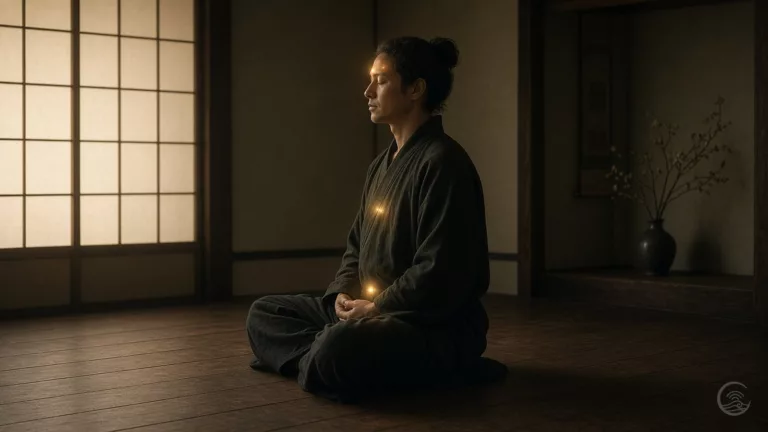
Visualising light in the body. In an earlier chapter, the same text describes a visualisation. Quoting “secret essentials of the scriptures of the immortals”, it says: “Constantly hold in mind, in the heart, a qi as big as a hen’s egg, red inside and yellow outside” (常存念心中,有氣大如雞子,內赤外黃) [4]. The text claims that this “wards off the many evils and extends the years”, and that whoever visualises a blazing fire “can enter amid epidemics” [4]. These are traditional claims, not findings. The text’s own word for this is cunnian (存念, “keep in mind”). Visualisation, above all of the gods inside the body, is one of the two main types of Daoist meditation, alongside “inner contemplation” (neiguan, 内观), and early meditation texts ask the adept to visualise those inner gods [18]; we met an example in the Laozi zhongjing, which places a god in the lower dantian (see “The three dantians”).
“Intention is the horse of qi.” The short Scripture of Embryonic Breathing (胎息經), which we read in “Breath in the classics”, says: “When the spirit moves, qi moves; when the spirit rests, qi rests” (神行即氣行,神住即氣住). A commentary that the Daoist canon transmits separately under the name of “Master Huanzhen” (幻真先生), probably of Tang date, is included with it, unsigned, in the Daoist anthology Yunji qiqian [5, 21]. It explains: “This is what is meant by: intention is the horse of qi; moving and stopping, they follow each other” (所謂意是氣馬,行止相隨). To keep qi from scattering, it says, “first hold on to the spirit” (即先拘守其神) [5]. The Yunji qiqian was compiled by Zhang Junfang after the Daoist canon he had edited was completed in 1019, and presented to the next emperor [5], so this pairing of intention and qi was written down by the early eleventh century at the latest.
Later inner alchemy took a more critical view of visualisation itself. In the preface to his Wuzhen pian, Zhang Boduan lists visualisation among the methods that are “easy to meet but hard to complete” (see “Neidan, inner alchemy”). Within the tradition, then, visualisation was valued, practised and also criticised.
Intention in the internal martial arts
Label for this section: Tradition only (documented history; authorships traditional).
The taijiquan “classics”. A small group of short texts has, since Guan Baiyi’s Taijiquan jing of 1912, acquired the status of “classics” accepted in all taijiquan styles [8]. They are usually credited to Wang Zongyue and to Wu Yuxiang (1812–1880) and his nephew Li Yiyu; the historian Stanley Henning notes that, apart from the treatise attributed to Wang Zongyue, the most important of them in the Yang-style canon come from Wu’s writings, and the authorship and origins of these texts are still debated [7, 8]. One of them, the Shisan shi xinggong xinjie (十三勢行功心解, “Mental elucidation of practising the thirteen postures”), opens: “Use the heart-mind to move qi; make it sink and settle, and it can gather into the bones. Use qi to move the body; make it smooth and compliant, and the body can follow the heart-mind with ease” (以心行氣,務令沉著,乃能收斂入骨。以氣運身,務令順遂,乃能便利從心) [6]. It adds: “first in the heart-mind, then in the body” (先在心,後在身), and “intention and qi must change nimbly” (意氣須換得靈) [6]. A verse in the same collection puts the hierarchy as a court: “intention and qi are the ruler, bones and flesh the ministers” (意氣君來骨肉臣) [6]; the treatise on the thirteen postures (十三勢論), after describing how movement runs from the feet through the waist to the fingers, adds: “all this is intention, not the outside” (凡此皆是意,不在外面) [6]; and in partner practice, “the force may break off, but the intention does not” (勁斷意不斷) [6].
The same text then warns against the very thing it seems to recommend. “Throughout the body, the intention lies in the spirit, not in qi; dwell on qi and you stagnate” (全身意在精神,不在氣,在氣則滯) [6, 19]. (The Wikisource text has 全神, “the whole spirit”, here; Yang-lineage printed versions read 全身, “the whole body”, and Li Yiyu’s manuscript of 1881 reads 全身意在蓄神, “in gathering the spirit” [20].) In other words, the mind leads, but attending to “qi” as a thing to be pushed around is a mistake.
Guo Yunshen: true intention. The xingyiquan master Guo Yunshen, whose teaching on breath we read in “Internal and external”, describes, through his student Sun Lutang’s book of 1924, three stages of training [9]. At the third, the movements of the whole body are no longer driven by effort but “wielded solely with spirit and intention” (專以神意運用之) [9]. He quotes the boxing classics: “The boxing is without boxing, the intention is without intention; within no intention is true intention” (拳無拳,意無意,無意之中,是真意) [9]. And he warns: “If you seek only strength, you are bound by strength; if you seek only qi, you are bound by qi” (若專以求力。即被力所拘。專以求氣。即被氣所拘); whatever you gain, treat it “as if absent … neither forget nor help” (勿忘勿助) [9]. That is Mencius’ farmer, two thousand years later, in a boxing manual.
What science says
Label for this section: Early evidence.
We have found no study that tests the traditional idea that intention leads qi. What has been studied are its human ingredients: imagining movement, and attending to the inside of the body.
Imagining movement. A meta-analysis of 75 brain-imaging papers found that imagining a movement consistently recruits a large fronto-parietal network, along with subcortical and cerebellar regions, several of which also work during real movement; the primary motor cortex itself was not consistently activated [10]. This concerns imagined movement, not imagined qi, light or sound travelling through organs.
Attending to the body. Researchers call the sense of signals from inside the body interoception. A review by Norman Farb and colleagues describes it as partly a construction: what we feel is shaped by what we expect to feel, and contemplative practices “may” reduce biases in how we interpret bodily sensations [11]. Questionnaires such as the MAIA measure how people report their body awareness [12]. But reports and accuracy can differ. In one study, experienced meditators were no better than non-meditators at detecting their own heartbeat, yet rated their performance as better [13]. In another, long-term tai chi practitioners, who direct attention to their hands and fingertips as they move, had finer touch discrimination at the fingertip than matched controls [14]; the study was cross-sectional, so it cannot show that tai chi caused the difference.
One 2026 study did test Liu Zi Jue itself (Early evidence): in a randomised crossover with 20 healthy young adults who had at most a year’s experience, people answered a computer attention task (the Stroop colour-word test) slightly faster after one seated session of the six sounds than after quiet eyes-closed rest; accuracy did not change [23]. It was a single session, the comparison was rest rather than matched breathing or voicing, and the participants were healthy beginners who knew which condition they were in; the paper reports no blinding. So it cannot tell us which part of the practice made the difference, whether the effect lasts, or anything about everyday life or health.
This is where research and practice can meet: the felt sense that practitioners describe is a real experience that can be studied, even where the traditional explanation for it, such as qi following the mind, cannot be tested.
Qigong as a package. Qigong and tai chi combine movement, breathing, attention and relaxation, and researchers describe them as “meditative movement”, defined by movement or posture, a focus on breathing, a calm or cleared state of mind and deep relaxation [15]. Peter Wayne and Ted Kaptchuk point out that this makes them complex interventions whose parts are hard to separate [16]. A small study of 19 Qigong practitioners found that their mood shifted towards the positive from before to after sessions and that they reported flow-like experiences during them, but the study had no control group [17]. None of these studies isolated intention or visualisation, and, apart from the single-session study above [23], none tested Liu Zi Jue. For what systematic reviews say about Qigong and tai chi overall, see “Qigong and tai chi: what systematic reviews say”.
Where popular claims go beyond the evidence
Label for this section: Speculative.
“Where the mind goes, qi follows.” This saying is widely repeated in Qigong teaching. We have not traced the English wording to a particular source. The closest Chinese counterpart we have found is “where intention arrives, qi arrives” (意到則氣到), in a text headed as the work of Gushenzi (Pei Xing) and preserved in the Yunji qiqian, which in the same sentence calls the heart “the horse of qi” [22]. Its older relatives are the sayings above, from Mencius’ “where the will arrives” to “intention is the horse of qi” [1, 5]. In the tradition it is a teaching image. No study measures qi following attention.
“Visualising light in an organ heals it.” The oldest visualisations claimed to ward off evils and epidemics [4]. These are traditional claims; no study we know of supports them, and a visualisation is not a substitute for medical care.
“Intention can change matter.” Claims that the mind shapes physical reality are often dressed in the language of quantum physics; our article “Quantum healing” and the observer effect explains what physicists actually mean.
“The harder you concentrate, the stronger the effect.” The classics say the opposite: “dwell on qi and you stagnate”, “neither forget nor help” [1, 6, 9]. If concentration makes your breathing tight or your body tense, the texts would say you are pulling at the sprouts. If you have a health condition, read “Who should be careful with breathing practices” first.
How this relates to the Six Healing Sounds, Qigong and neigong
Label for this section: Tradition only (documented history); my own approach is marked as mine, with its own label.
The link to the sounds is direct: the first text that names the six exhalations asks those who use them against illness to breathe them “with reverence and with the mind applied” [4], and the same work contains a visualisation of coloured qi in the heart [4]. What it does not do is ask the practitioner to send the sound to an organ; that pairing of sounds with organs appears in its list of illnesses (in this passage, heart, lungs, spleen and liver), not as a visualisation [4]. The 2003 standard form of Health Qigong Liu Zi Jue, compiled by the Health Qigong Management Center, asks for a quiet mind and a relaxed body in its opening stance, as described in “Stillness and posture”; we have not seen what the official 2003 book says about intention in the individual sounds.
How I practise the sounds. My practice is breath-led: you breathe in quietly through the nose and breathe the six sounds out through the mouth, “voiced through the breath”, not sung, working over time towards a silent exhalation. The breathing stays slow and controlled throughout, with no breath holds and no fast breathing. In my immersions we practise the sounds standing, in the wuji posture (无极, “without limit”), for those who are able to stand comfortably. Neidan is not part of my immersions; we use neigong and visualisation.
Label for the next paragraph: 🟠 Speculative · 🟣 Lived experience, from my own practice.
How I use visualisation. I add a visualisation in the spirit of neigong: you imagine yourself as the resonance, travelling with each sound to its organ, and with xi through the whole body (the triple burner; see “The triple burner”). This rests on my own experience and that of participants in my immersions, not on a scientific finding; I see my work as bridging the gap between the science and the experience. The texts above suggest one way to hold it: lightly, as an image that gives the attention somewhere to rest, not as a force to be pushed. What can be felt is the vibration of your own voice, as “What resonance really is” explains; we know of no measurements of a particular sound vibrating a particular organ (see “Vowels and formants”). Lived experience is an honest account of what people notice; it is not proof, and you may notice something different. None of this is a health claim.
Resonance Heritage Qi is a personal, music-assisted practice inspired by Liu Zi Jue: connected to it, not a replacement for the traditional form or for study with a teacher of that tradition.
Where this series goes next
This article opens part two of our neigong series, on inner principles. The next article turns from the mind to the body: “Song 松: relaxed and rooted”, on how the internal traditions relax without collapsing. To start part one from the beginning, read “What is neigong? An introduction”.
Enjoyed this article? Get my free practice guide to the Six Healing Sounds. Just sign up below, confirm your email, and it’s on its way.
Sources
- 孟子 Mengzi, 公孫丑上 Gongsun Chou I (2A2). Chinese text, Wikisource edition, accessed 20 October 2026. https://zh.wikisource.org/wiki/孟子/公孫丑上
- Van Norden B. Mencius. Stanford Encyclopedia of Philosophy, first published 16 October 2004, substantive revision 27 September 2024. https://plato.stanford.edu/entries/mencius/
- 管子 Guanzi, chapter 49, 內業 Neiye. Chinese text, Wikisource edition, accessed 20 October 2026. https://zh.wikisource.org/wiki/管子/第49篇內業
- Tao Hongjing (attributed). 養性延命錄 Yangxing yanming lu, juan 1, chapter 3 (雜戒忌禳災祈善篇), and juan 2, chapter 4 (服氣療病篇). Chinese text, Wikisource edition, accessed 20 October 2026. https://zh.wikisource.org/wiki/養性延命錄
- Zhang Junfang 張君房 (comp.). 雲笈七籤 Yunji qiqian, juan 60, 胎息經 Taixi jing with commentary (unsigned in the Yunji qiqian; attributed to Huanzhen xiansheng 幻真先生 in the separate canonical text 胎息經註, DZ 130); and Zhang Junfang’s preface. Chinese text, Wikisource editions, accessed 20 October 2026. https://zh.wikisource.org/wiki/雲笈七籤/60 ; https://zh.wikisource.org/wiki/雲笈七籤/序
- 太極拳經 Taijiquan jing (compilation headed 山右王宗岳 “Wang Zongyue of Shanxi”): 十三勢行功心解, 十三勢歌, 十三勢論, 打手歌. Chinese text, Wikisource edition, accessed 20 October 2026. https://zh.wikisource.org/wiki/太極拳經
- Henning SE, 1994. Ignorance, legend and taijiquan. Journal of the Chen Style Taijiquan Research Association of Hawaii 2(3), Autumn/Winter 1994:1–7. Online reprints, accessed 20 October 2026. http://bgtent.com/naturalcma/henning.html ; https://crnagorataiji.wordpress.com/wp-content/uploads/2015/12/legend-in-tai-chi.pdf
- Wile D, 2017. Fighting words: four new document finds reignite old debates in taijiquan historiography. Martial Arts Studies 4:17–35. https://doi.org/10.18573/j.2017.10184
- Sun Lutang 孫祿堂 (Sun Fuquan 孫福全). 拳意述真 Quanyi shuzhen (Authentic explanations of martial arts concepts), published 1924: chapter 4, sayings of Guo Yunshen 郭雲深. Chinese text with English translation by Paul Brennan, Brennan Translation, 2013, accessed 20 October 2026. https://brennantranslation.wordpress.com/2013/04/29/the-voices-of-sun-lutangs-teachers/
- Hétu S, Grégoire M, Saimpont A, Coll MP, Eugène F, Michon PE, Jackson PL, 2013. The neural network of motor imagery: an ALE meta-analysis. Neuroscience & Biobehavioral Reviews 37(5):930–949. https://doi.org/10.1016/j.neubiorev.2013.03.017
- Farb N, Daubenmier J, Price CJ, Gard T, Kerr C, Dunn BD, Klein AC, Paulus MP, Mehling WE, 2015. Interoception, contemplative practice, and health. Frontiers in Psychology 6:763. https://doi.org/10.3389/fpsyg.2015.00763
- Mehling WE, Price C, Daubenmier JJ, Acree M, Bartmess E, Stewart A, 2012. The Multidimensional Assessment of Interoceptive Awareness (MAIA). PLoS ONE 7(11):e48230. https://doi.org/10.1371/journal.pone.0048230
- Khalsa SS, Rudrauf D, Damasio AR, Davidson RJ, Lutz A, Tranel D, 2008. Interoceptive awareness in experienced meditators. Psychophysiology 45(4):671–677. https://doi.org/10.1111/j.1469-8986.2008.00666.x
- Kerr CE, Shaw JR, Wasserman RH, Chen VW, Kanojia A, Bayer T, Kelley JM, 2008. Tactile acuity in experienced Tai Chi practitioners: evidence for use dependent plasticity as an effect of sensory-attentional training. Experimental Brain Research 188(2):317–322. https://doi.org/10.1007/s00221-008-1409-6
- Larkey L, Jahnke R, Etnier J, Gonzalez J, 2009. Meditative movement as a category of exercise: implications for research. Journal of Physical Activity and Health 6(2):230–238. https://doi.org/10.1123/jpah.6.2.230
- Wayne PM, Kaptchuk TJ, 2008. Challenges inherent to t’ai chi research: part I – t’ai chi as a complex multicomponent intervention. Journal of Alternative and Complementary Medicine 14(1):95–102. https://doi.org/10.1089/acm.2007.7170a
- Pölönen P, Lappi O, Tervaniemi M, 2019. Effect of meditative movement on affect and flow in qigong practitioners. Frontiers in Psychology 10:2375. https://doi.org/10.3389/fpsyg.2019.02375
- Pregadio F, 2006. Early Daoist meditation and the origins of inner alchemy. In: Penny B (ed.), Daoism in History: Essays in Honour of Liu Ts’un-yan. London and New York: Routledge, pp. 121–158. Author’s PDF, accessed 20 October 2026. https://www.fabriziopregadio.com/files/PREGADIO_Early_Daoist_Meditation.pdf
- Chen Yanlin 陳炎林. 太極拳刀劍桿散手合編 Taijiquan dao jian gan sanshou hebian, 1943, appendix. Chinese text with English translation by Paul Brennan, Brennan Translation, 2013, accessed 20 October 2026. https://brennantranslation.wordpress.com/2013/03/29/an-outline-of-taiji-theory/
- Li Yiyu 李亦畬. Handwritten manual presented to Hao He (Weizhen), 1881. Chinese text with English translation by Paul Brennan, “The Taiji Classics”, Brennan Translation, 2013, accessed 20 October 2026. https://brennantranslation.wordpress.com/2013/05/25/the-taiji-classics/
- 胎息經註 Taixi jing zhu (DZ 130), headed 幻真先生註. Chinese text, Wikisource edition, accessed 20 October 2026. https://zh.wikisource.org/wiki/胎息經註
- 雲笈七籤 Yunji qiqian, juan 88, 道生旨 Daosheng zhi (headed 谷神子裴鉶述). Chinese text, Wikisource edition, accessed 20 October 2026. https://zh.wikisource.org/wiki/雲笈七籤/88
- Bi Y, Guan H, Wang J, Cheng Y, Ying Z, 2026. The multimodal neurophysiological assessment of immediate LiuZiJue: revealing executive control and brain function changes. Frontiers in Neurology 17:1865496. https://doi.org/10.3389/fneur.2026.1865496
Source quality note: [1], [3], [4], [5], [6] and [9] are primary Chinese texts, read in Wikisource editions (for [9], a translator’s bilingual edition), some of them only partly proofread; the translations are our own working translations, checked for [9] against Paul Brennan’s. [2] is a peer-reviewed encyclopedia entry by a specialist, and [18] a scholarly book chapter, read in the author’s PDF. The authorship of the taijiquan texts in [6] is traditional; for their history we rely on a short article by a historian [7], read in online reprints, and a peer-reviewed study [8]. The Yunji qiqian is dated here from its compiler’s own preface [5]. [10] is a meta-analysis and [11] a review; [12] is a questionnaire study; [13], [14] and [17] are small studies, [14] cross-sectional and [17] without a control group; [15] and [16] are methodological papers. None of [10]–[17] tested Liu Zi Jue or the traditional claims quoted above. [23] is a single small, exploratory laboratory study of one Liu Zi Jue session in healthy young adults, with a rest-only control; it did not test the traditional claims either. [19] and [20] are later printed and manuscript versions of the taijiquan texts in [6], read in a translator’s bilingual editions; [21] and [22] are primary Daoist texts in Wikisource editions, and the attributions in their headings are traditional.
Disclaimer
This article is for general education only. It is not medical advice and does not replace diagnosis or treatment by a doctor or other qualified health professional. Qigong and the Six Healing Sounds are traditional practices; we make no claims that they cure, treat or prevent any illness. If you have a health condition, are pregnant, or are unsure whether a practice suits you, please talk to your doctor first.