Daoyin: from the Mawangdui chart to modern Qigong
Evidence label: Tradition only
This is a history article. Where a statement rests on a surviving text or an excavated manuscript, we say so; where we rely on a scholar’s reading or transcription, we name the scholar.
In short
- What this is: Daoyin (导引, traditional 導引, dǎoyǐn), “guiding and pulling”, is the old Chinese name for exercises that combine stretching, movement and breathing. This article follows it from a passage in the Zhuangzi, through two manuscripts buried in the 2nd century BCE, to the “Qigong” of the 1950s and the Health Qigong sets of today. It is the first article of our neigong series.
- What the evidence says: The history is unusually well documented: a painted chart sealed in a tomb in 168 BCE, a bamboo manual from a tomb of about 186 BCE, and a long line of later texts. What these exercises do for health in a modern sense is a separate question; the old texts state traditional beliefs, not tested results.
- What it means for your practice: Breathing out on chui and xu, two sounds that later became part of Liu Zi Jue, is attested more than 2,000 years ago. The six-sound method itself is younger, and modern Qigong is a 20th-century reshaping of these traditions, not an unbroken copy of them.
What tradition says
Label for this section: Tradition only (documented history), unless marked otherwise.
The Zhuangzi passage. The earliest well-known mention of daoyin is in the Zhuangzi, the Daoist classic named after Zhuangzi, who flourished in the second half of the 4th century BCE. The passage is in chapter 15, Keyi (刻意, translated by James Legge as “Ingrained Ideas”), one of the “Outer Chapters” (8–22). Guo Xiang (died 312 CE), who edited the version of the text that survives, attributed only the “Inner Chapters” (1–7) to the period of Zhuangzi’s own lifetime [1, 2]. The original reads: 吹呴呼吸,吐故納新,熊經鳥申,為壽而已矣;此導引之士,養形之人,彭祖壽考者之所好也 [1].
In our translation: “Blowing and puffing, breathing out and breathing in, expelling the old and taking in the new, bear-amblings and bird-stretchings: all this is simply for long life. This is what the practitioners of daoyin, those who nourish the body, and those who hope to live as long as Pengzu, delight in” [1]. Pengzu is a legendary figure famed for his great age. Some editions write the word as 道引 instead of 導引; the meaning is the same [1].
Three things are worth noticing. First, the passage pairs breath and movement from the start: chui (吹, chuī, “blowing”) and xu (呴, xǔ, “puffing”, “breathing out warmly”) stand beside the “bear” and “bird” stretches. Second, chui reappears among the six sounds of Liu Zi Jue, and a breath called xu does too, although the later sound is written with a different character (嘘, xū). The texts do not tell us whether the two were exactly the same breath. Third, the passage is not praise. Its next lines say that the sage reaches long life “without daoyin” (不導引而壽), by stillness and emptiness rather than exercise [1]. The Zhuangzi treats daoyin as one pursuit among several that miss the point. The tradition we follow here grew up anyway.
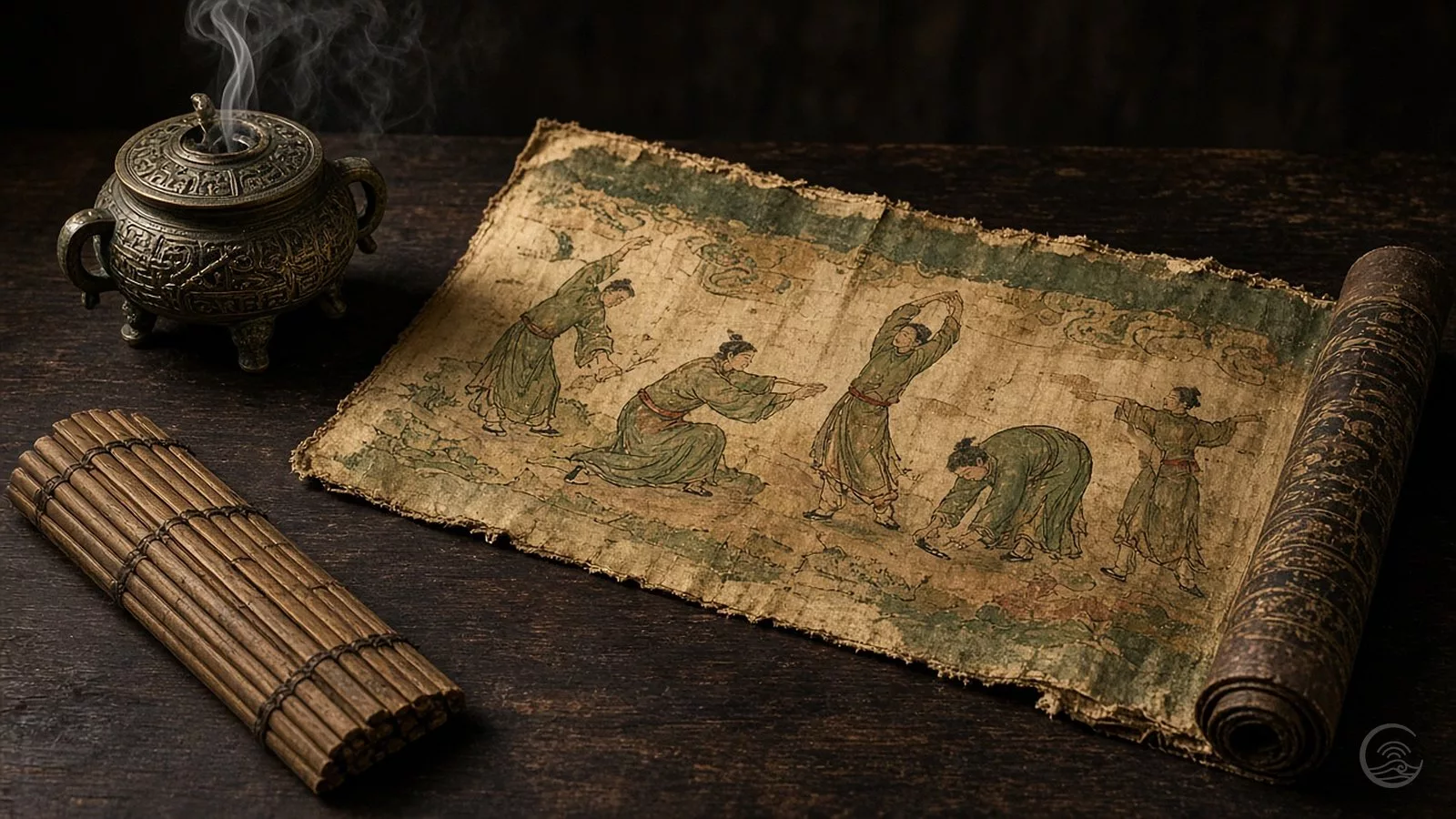
The Mawangdui chart (sealed 168 BCE). In 1973 archaeologists excavating tomb 3 at Mawangdui, near Changsha in Hunan, found a lacquer box of silk manuscripts. A dated wooden tablet in the tomb fixes the burial in the twelfth year of Emperor Wen of Han, 168 BCE, so the manuscripts were copied no later than that [3, 4]. One sheet of silk, about 50 cm high, carries two texts and a painting: a short opening section holds a text known as Quegu shiqi (却谷食气, “Abstaining from grain and eating qi”) and then a text on the vessels, and a chart of exercising figures fills most of the rest [5]. Published figures for the length of the sheet differ, from about 100 to about 140 cm [5]. The chart has no title of its own; modern editors named it Daoyin tu (导引图, “Daoyin chart”) [3].
The chart shows 44 small painted human figures, standing, bending and stretching; one holds a staff. It is badly damaged, and many captions are illegible, so what most people see today is a modern reconstruction [3]. Some legible captions name complaints: “Stretching for knee pain” (引膝痛), “Stretching for deafness” (引聾). Others name animals or actions: a “crane”, a “monkey”, the “bear” (熊經, written 熊巠 on the silk) that also appears in the Zhuangzi, and one figure, number 34, captioned yanghu (仰呼), “looking up while exhaling” or “looking up and shouting” [3]. We follow the scholar Louis Komjathy’s caption list here; an English translation with text-critical notes was published by Donald Harper in 1998 [3]. Komjathy also warns that the animal figures are separate exercises, not yet a set like the later Five Animal Frolics [3].
The text on the same silk matters for breathing. The surviving Quegu shiqi is fragmentary, but it says that “those who eat qi practise xu and chui” (食氣者為呴吹), and it uses xu and chui when “the head feels heavy and the feet light” [6]. So in this tomb, a breathing text using two of the Zhuangzi’s breath words sits on the same silk as the exercise chart.
The Zhangjiashan Yinshu (about 186 BCE). A second find came in 1983–84, in tomb 247 at Zhangjiashan, near Jiangling in Hubei. Among legal and mathematical texts was a bamboo manuscript whose title, Yinshu (引书, traditional 引書, “Book on pulling” or “Book on stretching”), is written on the back of its first slip [7, 8]. A calendar found in the tomb shows that its owner died in 186 BCE, the second year of Empress Lü, or shortly after, so the burial is usually dated to about 186 BCE [4]. The historian Vivienne Lo, who translated the text, cites the excavators’ first report: judging by the grave goods, the burial took place no earlier than 186 BCE and no later than the start of Emperor Jing’s reign (156 BCE) [7]. The manuscript was copied before the burial. Lo calls it the earliest surviving treatise on daoyin [7].
The Yinshu is a practical manual. It opens with a seasonal regimen for washing, grooming, eating, sleep and sex, which it calls “the way of Pengzu”; it then names and describes dozens of exercises, many of them for specific complaints; and it closes with an explanation of why people fall ill [7, 8]. Several exercises match captions on the Mawangdui chart, including the “bear” [3].
Did the Yinshu use breath-exhalation methods such as chui, xu and hu? Yes, and in this it goes beyond the Zhuangzi. We could not see the bamboo slips or the official Chinese edition; the following rests on Vivienne Lo’s edition and translation [7] and on transcriptions published by Chinese scholars [8, 9]. The Yinshu uses three named exhalations: chui (吹, written 炊 on the slips), xu (呴, written 昫) and hu (呼, hū, written 虖, 謼 or 嘑) [7, 9]. One passage advises “chui, xu, hu and breathing in the essential qi of heaven and earth” (吹呴呼吸天地之精氣) alongside stretching [7, 8]. Another, for a swollen belly, says to lie on the back and do chui with full attention thirty times; if that does not help, hu ten times; if that does not help, xu ten times; then chui thirty times again; and only if that fails, to get up and stretch [7, 9]. The text also ties the breaths to the seasons (“in spring, xu twice, hu once and chui once; in summer, hu twice…”; it gives rules for spring, summer and winter, but none for autumn) and to emotions: “when joyful, quickly xu; when angry, strongly chui, to bring it into balance” [7, 8]. One modern analysis lists the breathing methods used across the manual’s 44 conditions: xu, hu, chui, quick hu and xu, not breathing (毋息), breathing in “food qi” (吸飯氣), and breathing in essential qi and swallowing it [8]. There is no he, si or xi on that list, and nothing in the passages we could check sets up the later scheme of six sounds paired with organs.
After the manuscripts: a living line of texts. Daoyin did not stay buried. A few landmarks, all in surviving texts:
- The Five Animal Frolics. The official histories Sanguozhi (三國志) and Hou Hanshu (後漢書) quote the physician Hua Tuo, who was called to serve the warlord Cao Cao: “The immortals of old practised daoyin: the bear’s ambling and the owl’s glance, pulling and stretching the waist and body, moving all the joints, so as not to grow old. I have a method called the Frolic of the Five Animals: the tiger, the deer, the bear, the ape and the bird” [10]. (The Sanguozhi edition writes 熊頸, “bear’s neck”; the Hou Hanshu has 熊經, as in the Zhuangzi.) Komjathy dates the Five Animal Frolics possibly to the late 2nd century CE [3].
- The Yangxing yanming lu. The same anthology that first records the six sounds, in its chapter on ingesting qi (服氣療病篇), has the next chapter on “daoyin and massage” (導引按摩篇), which describes the Five Animal Frolics movement by movement [11]. As our Liu Zi Jue history explains, the text is traditionally attributed to Tao Hongjing (died 536), and scholars date the surviving compilation to between the 6th and 8th centuries.
- Medicine. The Zhubing yuanhou lun (諸病源候論, “On the origins and symptoms of all diseases”), compiled under the Sui dynasty in the Daye era (605–618) by the court physician Chao Yuanfang and others, repeatedly adds daoyin instructions, quoted from a “Yangsheng fang daoyin fa” (養生方導引法, “daoyin methods from the formulas for nourishing life”), to its descriptions of disorders [12].
- The Daoist Canon. Collections such as the Taiqing daoyin yangsheng jing (太清導引養生經), an anonymous text in the Ming-dynasty Daoist Canon of the Zhengtong era (completed in 1445), gather sequences attributed to legendary immortals such as Chisongzi [13].
- Liu Zi Jue joins movement. According to the Chinese Health Qigong Association, Liu Zi Jue was a breathing practice only until the Ming dynasty; Ming texts are the first to pair the sounds with movements [14].
From daoyin to “Qigong”
Label for this section: Tradition only (documented history).
The word that now covers all of this is recent. According to the historian David Palmer, the term Qigong (气功, qìgōng) had appeared only rarely before, and the cadre Liu Guizhen and his colleagues adopted it in southern Hebei in the late 1940s for the breathing methods they taught; it became a general term only after 1949 [15]. A study by Utiraruto Otehode and Benjamin Penny gives a detail of the naming: when a Hebei medical team examined Liu Guizhen’s practice early in the 1950s, doctors of Chinese medicine wanted to call it naqi daoyin (纳气导引), “ingesting qi and guiding it”, but the team leader proposed Qigong, because qi could be read both as oxygen in Western medicine and as primordial qi in Chinese medicine [16]. The sources differ in timing; both agree that the name was a deliberate modern choice.
In the 1950s, “Qigong therapy” became a generic name for two practices taught in medical institutions, starting with the Tangshan Qigong Sanatorium, founded in 1954 [16]. Otehode and Penny conclude that, although built on long-standing practices, Qigong therapy “actually represented a break from tradition”: religious and “superstitious” explanations were removed and replaced by medical theory of the time [16]. They also note where the modern claim of a 2,000-year history comes from: older texts describe daoyin and tuna, which look similar, but never use the word Qigong [16].
Health Qigong: standard forms. In 2003, China’s General Administration of Sport issued four newly compiled “Health Qigong” sets, Yijinjing, Wuqinxi (the Five Animal Frolics), Liu Zi Jue and Baduanjin, and promoted them nationwide. In 2009 five more followed, among them a Mawangdui daoyin shu (马王堆导引术), “Mawangdui daoyin method” [17]. That set is a modern composition named after the chart; the chart itself is a collection of separate exercises, many of whose captions are lost [3]. In the standard Liu Zi Jue, the six sounds are xu, he, hu, si, chui and xi, and beginners may voice them while the overall aim is to breathe out without sound [18], as our Liu Zi Jue history describes in more detail.
What science says
Label for this section: Early evidence (modern Qigong research) · Tradition only (the old texts’ health statements).
The Mawangdui and Zhangjiashan texts state what their authors believed about illness and exercise. They are evidence of history, not of medical effects. Modern research studies the modern sets. For Liu Zi Jue, that is mostly small trials in people with chronic lung disease, and a 2020 review of these trials points to methodological weaknesses [19]. Our article on slow breathing and heart rate variability explains what is well established about slow breathing itself.
Where popular claims go beyond the evidence
Label for this section: Speculative.
- “The Mawangdui chart proves Qigong is thousands of years old.” The chart shows that guided stretching with breathing was practised by 168 BCE. “Qigong” as a name and as a system is a 20th-century creation, and Komjathy notes that modern practitioners have used the chart as evidence of “ancient Qigong”, “which it is not” [3, 16].
- “The Health Qigong Mawangdui set is the ancient routine.” It is a modern composition, issued in 2009 and named after a damaged chart of separate exercises [3, 17].
- “The Six Healing Sounds are over 2,000 years old.” Breathing on chui and xu is that old [1, 6, 8]. The method of six sounds is first recorded between the 6th and 8th centuries [11].
- “An unbroken lineage from Zhuangzi to today.” There are many surviving texts across the centuries, but they are a family of related practices that changed constantly, not one transmitted form.
How this relates to the Six Healing Sounds, Qigong and neigong
Label for this section: Tradition only (documented history), with Raymond’s teaching marked as such.
Liu Zi Jue grew out of the daoyin world. The Zhuangzi names breathing on chui and xu more than 2,000 years ago [1]. The Mawangdui silk pairs xu and chui with an exercise chart [5, 6], and the Yinshu uses chui, xu and hu for specific complaints, seasons and moods [8, 9]. Three of the later six sounds therefore have a documented history in the 2nd century BCE, though written partly with different characters. The full set of six out-breaths, “one way of breathing in, six ways of breathing out”, first appears in the Yangxing yanming lu, written down between the 6th and 8th centuries, and the movements came in the Ming [11, 14]. Modern Health Qigong Liu Zi Jue is the 2003 standardised form of that long development [17, 18]. Our introduction to the series, “What is neigong?“, describes how practitioners also call this kind of breath work neigong, “internal work”.
How Raymond teaches the sounds. In our practice, as Raymond teaches it, xi is the whole-body sound of the triple burner, as in the 2003 standard form. All six sounds are breathed out through the mouth, voiced through the breath rather than sung, and over time our sessions work towards a silent exhalation, which the 2003 standard form also aims for [18]. The breathing stays slow and controlled throughout: no fast breathing and no breath holds. That is how we teach the sounds, not a claim about what the old texts prescribe. Some early texts include “quick” exhalations and not breathing (毋息) [7, 8]; we describe them as history, not as instructions. If you have a health condition, read who should be careful with breathing practices first.
Resonance Heritage Qi is a personal, music-assisted practice inspired by Liu Zi Jue: connected to it, not a replacement for the traditional form or for study with a teacher of that tradition.
Where this series goes next
This is the first article of our neigong series. Next: “Breath in the classics: tuna, fuqi, lianqi and embryonic breathing“, on what the old breathing terms meant.
Enjoyed this article? Get my free practice guide to the Six Healing Sounds. Just sign up below, confirm your email, and it’s on its way.
Sources
- Zhuangzi 莊子, chapter 15, 刻意 (Keyi). Chinese text, Wikisource edition, accessed 18 October 2026. https://zh.wikisource.org/wiki/莊子/刻意
- Hansen C. Zhuangzi. Stanford Encyclopedia of Philosophy, first published 17 December 2014, substantive revision 24 March 2024. https://plato.stanford.edu/entries/zhuangzi/
- Komjathy L, 2024. Caption List of the Dǎoyǐn tú 導引圖 (Illustrations of Guided Stretching). Center for Daoist Studies, posted 15 July 2024. https://louiskomjathy.com/wp-content/uploads/2025/01/DaoyintuCaptionList_Komjathy.pdf ; cites Harper D, 1998, Early Chinese Medical Literature: The Mawangdui Medical Manuscripts, London: Kegan Paul International (Sir Henry Wellcome Asian Series), pp. 310–16 (bibliographic details checked in the Wellcome Collection catalogue, https://wellcomecollection.org/works/m6972qq7 ; the book itself not seen by us).
- Pian Yuqian 骈宇骞. 《出土简帛书籍题记述略》提要 (summary of A survey of title notes in excavated bamboo and silk books). Confucian Bamboo and Silk Studies, Shandong University, accessed 18 October 2026. http://www.jianbo.sdu.edu.cn/info/1014/1295.htm ; see also Wellcome Collection, Daoyin tu (reconstruction), record rrb7c7cm. https://wellcomecollection.org/works/rrb7c7cm
- Hunan Museum 湖南博物院. 文献考古史上的空前发现:马王堆汉墓帛书集粹 (Mawangdui silk manuscripts), section on 《阴阳十一脉灸经》乙本、《却谷食气》和《导引图》, accessed 18 October 2026. https://www.hnmuseum.com/sites/default/files/statics/zhutishoucang/03马王堆汉墓帛书集粹/BookOnSilk/collections5.html ; Mayanagi Makoto 真柳誠, 1987. Review of 馬王堆漢墓帛書〔肆〕 (Mawangdui silk manuscripts, vol. 4, 1985). Nihon Ishigaku Zasshi 33(2): 272–274. http://square.umin.ac.jp/mayanagi/paper03/mawangtui.html ; Zhou Shirong 周世荣 (Hunan Provincial Institute of Cultural Relics and Archaeology). 长沙马王堆汉墓导引图复原记 (How the Mawangdui Daoyin tu was restored), online repost dated 21 September 2012. http://qigong.arkoo.com/sf_0A82675FB6D64839882ABE8E5718B70F_17_zhangtiange.html
- 馬王堆漢墓簡帛 Mawangdui Han tomb manuscripts: 去穀食氣 (Quegu shiqi). Chinese text, Wikisource edition, accessed 18 October 2026. https://zh.wikisource.org/wiki/馬王堆簡帛/去穀食氣
- Lo V, 2014. How to do the Gibbon Walk: A Translation of the Pulling Book (ca. 186 BCE). Needham Research Institute Working Papers 3. Cambridge: Needham Research Institute. Description page: https://www.nri.cam.ac.uk/1569-2/ ; the PDF link on that page is broken, so we read the copy archived by the Internet Archive: https://web.archive.org/web/20211014011021/https://www.nri.org.uk/yinshu.pdf
- Zhao Dan 赵丹, 2024. 张家山汉简《引书》内容简析 (A brief analysis of the content of the Zhangjiashan Yinshu). Chinese Medical Qigong Society, 27 August 2024 (from the proceedings of its 21st annual conference). https://www.cmqg.cn/Home/Details/fb68c8ae-7f31-45a6-905c-c29af38df429
- Jiao Minjing 焦民敬. 說張家山漢簡《引書》的”引癉病之始也” (On the phrase 引癉病之始也 in the Zhangjiashan Yinshu). Fudan University Center for Research on Chinese Excavated Classics and Paleography. http://www.fdgwz.org.cn/Web/Show/4584 ; and Zhao Dan, Xu Feng, 2024. 读张家山汉简《引书》札记十九则 (Nineteen notes on the Zhangjiashan Yinshu). https://m.fx361.com/news/2024/0104/22881849.html
- 三國志 Sanguozhi, juan 29 (biography of Hua Tuo); 後漢書 Hou Hanshu, juan 82B (biography of Hua Tuo). Chinese text, Wikisource editions, accessed 18 October 2026. https://zh.wikisource.org/wiki/三國志/卷29 · https://zh.wikisource.org/wiki/後漢書/卷82下
- Tao Hongjing (attributed). 養性延命錄 Yangxing yanming lu, chapters 服氣療病篇第四 and 導引按摩篇第五. Daoist Canon (Zhengtong Daozang) text, digital edition: Kanripo, KR5c0235, as in our Liu Zi Jue history article. https://www.kanripo.org/text/KR5c0235/002 ; also Wikisource edition, accessed 18 October 2026. https://zh.wikisource.org/wiki/養性延命錄
- Chao Yuanfang 巢元方 et al. 諸病源候論 Zhubing yuanhou lun. Chinese text, Wikisource edition, accessed 18 October 2026. https://zh.wikisource.org/wiki/諸病源候論
- 太清導引養生經 Taiqing daoyin yangsheng jing. Chinese text, Wikisource edition (Zhengtong Daozang), accessed 18 October 2026. https://zh.wikisource.org/wiki/太清導引養生經 ; on the date of the Zhengtong Daozang (completed 1445): National Cultural Heritage Administration of China, 2017. 《正统道藏》《万历续道藏》即将复制出版 (news release, 31 December 2017). http://www.ncha.gov.cn/art/2017/12/31/art_722_146223.html
- Chinese Health Qigong Association, 2016. 健身气功·六字诀功法源流 (Health Qigong Liu Zi Jue: origins of the method). Health Qigong Management Center, General Administration of Sport of China, published 20 December 2016. https://www.sport.gov.cn/qgzx/n5407/c781291/content.html
- Palmer DA, 2005. Qigong. In Davis E (ed.), Encyclopedia of Contemporary Chinese Culture. London: Routledge. Pre-publication version: https://hub.hku.hk/bitstream/10722/194528/2/Content.pdf
- Otehode U, Penny B, 2016. Qigong therapy in 1950s China. East Asian History 40. https://eah.anu.edu.au/40/Otehode-and-Penny/index.html
- Health Qigong Management Center, General Administration of Sport of China, 2017. “我要上全运”:健身气功无锡滨湖区海选 (news report, 17 April 2017, with background on the 2003 and 2009 sets). https://www.sport.gov.cn/qgzx/n5406/c798212/content.html
- Zhang Mingliang, Ma Ling, 2016. 健身气功·六字诀养生撷萃 (Health Qigong Liu Zi Jue: essentials for nourishing life). Health Qigong Management Center, published 11 November 2016. https://www.sport.gov.cn/qgzx/n5407/c775164/content.html
- Xiao L, Duan H, Li P, Wu W, Shan C, Liu X, 2020. A systematic review and meta-analysis of Liuzijue in stable patients with chronic obstructive pulmonary disease. BMC Complementary Medicine and Therapies 20:308. https://doi.org/10.1186/s12906-020-03104-1
Source quality note: [1], [6], [10], [11], [12] and [13] are primary Chinese texts; [11] is read in the Kanripo edition of the Daoist Canon text, the others in Wikisource editions. The translations are our own working translations. [6] is a modern transcription of a damaged excavated manuscript. For the Yinshu we could not see the bamboo slips or the official edition (Zhangjiashan Han mu zhujian, 2001, revised 2006); we quote it from Lo’s edition and translation [7], compared with transcriptions published by Chinese scholars [8, 9]. The forms written on the slips come from [7] and [9]; part of [9] was read only in search-engine extracts. [2], [3], [7], [15] and [16] are scholarly sources; Harper’s 1998 translation is cited through [3] and was not seen by us. [4] is a scholarly survey. [5] combines a museum page, read only in a search-engine extract because it did not load for us, with two scholarly accounts read in full; they differ on the length of the silk. [14], [17] and [18] are official publications of the body that created the Health Qigong sets, so they represent its own view. [19] is cited only for the state of clinical research.
Disclaimer
This article is for general education only. It is not medical advice and does not replace diagnosis or treatment by a doctor or other qualified health professional. Qigong and the Six Healing Sounds are traditional practices; we make no claims that they cure, treat or prevent any illness. If you have a health condition, are pregnant, or are unsure whether a practice suits you, please talk to your doctor first.