The triple burner: “a name but no form”
The triple burner (san jiao) in the Nanjing, Lingshu and Suwen, the long debate over its form, its link to the sound xi, and why it is not the dantians.

The triple burner (san jiao) in the Nanjing, Lingshu and Suwen, the long debate over its form, its link to the sound xi, and why it is not the dantians.

Where the upper, middle and lower dantian lie in the Baopuzi, the Yellow Court and other classics, how they differ, and why they are not the triple burner.

What qigong means: the modern word 气功, its roots in daoyin, the 1950s clinics, the qigong boom, China’s Health Qigong forms, and where Liu Zi Jue fits.

What tuna, xingqi, fuqi, lianqi and embryonic breathing mean in the Chinese classics, and where Liu Zi Jue’s “one way in, six ways out” fits.
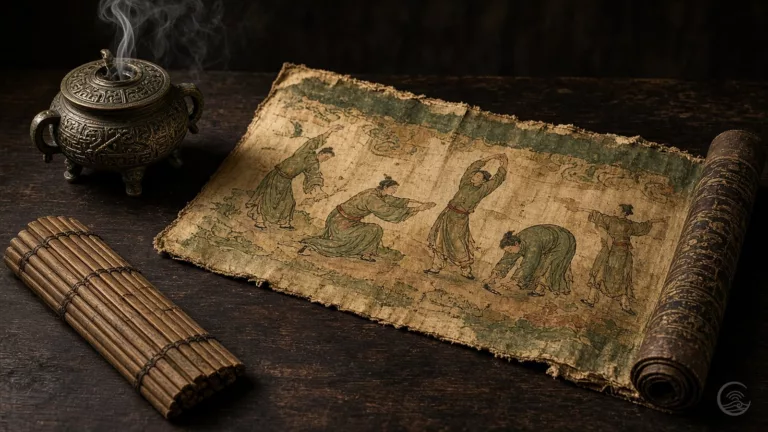
Daoyin, “guiding and pulling”: the Zhuangzi passage, the Mawangdui chart, the Zhangjiashan Yinshu, later manuals, and how it led to modern qigong.

What neigong means: the word 内功, its roots in daoyin and breath practice, martial “internal” arts, Daoist inner alchemy, and how it relates to qigong.

What systematic reviews say about qigong and tai chi: falls, blood pressure, COPD and Liu Zi Jue, the quality problems, and what is and isn’t supported.

How your mouth shapes sound: the source-filter model, formants F1 and F2, and what the Six Healing Sounds are acoustically, from hiss to vowel.

Where do the Six Healing Sounds come from? The earliest text, its uncertain date, changing organ pairings and the 2003 standard form of Liu Zi Jue.