Who was Professor Zhang Guangde?
Evidence label: Documented history
Evidence label: Tradition only
This is a biography and history article. The main facts of Zhang Guangde’s career are documented by Beijing Sport University and China’s Health Qigong Management Center. The story of how his method began, and the ideas behind it, come mostly from Zhang himself, his students and the bodies that promote his work. Where a statement is an insider’s account, we say so.
Author: Raymond Hackland · Last reviewed: 21 October 2026 · Reading time: about 10 minutes
In short
What this is: An introduction to Zhang Guangde (张广德), a professor at Beijing Sport University and the creator of Daoyin Yangsheng Gong (导引养生功), a large system of gentle health exercises. It covers his life, his work at the university, how his system is built, how it relates to the old Chinese tradition of daoyin, his part in the official Health Qigong forms, and what he left behind. It is the first article of a new series on his work; the second, “The Twelve Daoyin Exercises”, looks at the Health Qigong form built from his routines.
What the evidence says: His career, his death in 2022 and his role in one Health Qigong form are well documented in official sources. Some personal details differ between sources, including his year of birth. The research on his exercises is small and mostly Chinese; a few small trials of single routines exist, but no large independent evaluation of the system.
What it means for your practice: Daoyin Yangsheng Gong is a modern system, created by one teacher from the 1970s onwards. It draws on old daoyin ideas and on Chinese martial arts, but it is not an ancient form handed down unchanged. Knowing this helps you place it beside the older traditions and the official Health Qigong forms.
What tradition says
Label for this section: 📜 Documented history, unless marked otherwise.
A life in brief
Zhang Guangde was born in Tangshan, in Hebei province [2, 17]. The sources do not agree on the date. Most give March 1932, including a 2024 report by Beijing Sport University [21], the author note in his own 2003 textbook [12] and an Australian school whose chief instructor was his student [17]. A Chinese study of his ideas also starts his life in 1932 [5]. Two German sources give 1931; the Taijiquan & Qigong Journal names 15 April 1931 [2, 3]. The official notice of his death gives his age as 91 [1]. Age in China is often counted in a way that adds one or two years to the Western age, so this figure fits either year. We have not found a primary record, such as a university file, that settles the question.
He studied Chinese martial arts (wushu) at the Beijing Institute of Physical Education, today Beijing Sport University. Most sources give 1955 as the year he began his studies [3, 16, 17]; the Taijiquan & Qigong Journal says 1954 [2]. One of his students writes that he graduated in wushu in 1959 and then stayed on to teach [16]. His students describe him as one of China’s first postgraduate students in wushu, and name the wushu professor Zhang Wenguang as his teacher there [16, 17].
Zhang Guangde died in Beijing on 30 January 2022. The Health Qigong Management Center and the Chinese Health Qigong Association announced his death the same day, called him a “famous Health Qigong expert” and gave his age as 91. In keeping with his own wishes, the funeral was simple [1]. The German Taijiquan & Qigong Journal reported his death a week later [2].
Label: 📜 Documented history.
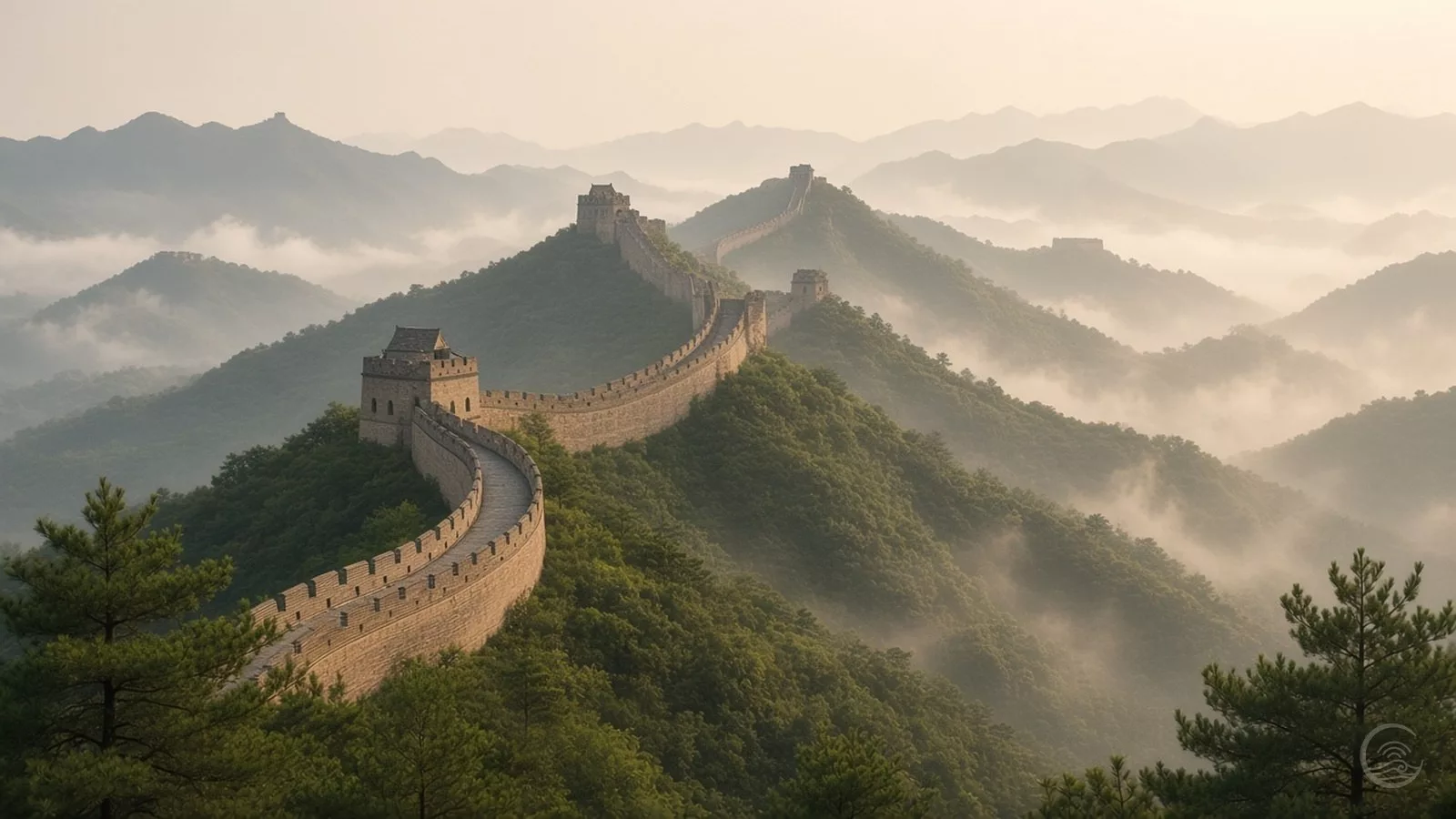
In April 2024 his family and students unveiled a bronze relief of Zhang and his wife on their gravestone at Badaling Cemetery, at the foot of the Great Wall outside Beijing [21]. According to the cemetery, the couple now rest in its Sixian Garden [22].
Illness and a new beginning
Label: 📜 Documented history (that this is the account given) · 🔵 Tradition only (what the exercises are said to have done).
The story of how his method began is told by Zhang’s students, by associations that teach his system and by a Chinese study of his ideas [2, 3, 5, 16]. In the early 1970s he became seriously ill. According to these accounts, he was diagnosed with lung cancer in 1974, he had several other illnesses, and allergies limited the medicines he could take [5, 16, 17]. He then studied classical texts on daoyin and Chinese medicine and began to design exercises for himself [2, 3]. The Taijiquan & Qigong Journal says he started with 14 exercises, which grew into the 49-movement “meridian exercise” that became the start of his system [2]. In 1982, the German association writes, he returned to teaching at the university [3].
His students and the promoting bodies credit the exercises with his recovery [3, 16]. This is how the tradition of his method tells its own beginning, and we report it as that. We cannot check the medical details, and one person’s recovery is not evidence that an exercise treats any illness.
His work at Beijing Sport University
The university’s own account gives the main steps [4]:
- 1970s: Zhang creates Daoyin Yangsheng Gong and begins to spread it.
- 1986: the university starts compulsory and elective courses in Daoyin Yangsheng Gong.
- 1990: it starts taking master’s students in Daoyin Yangsheng Gong.
- 1990s: the method becomes teaching material for public physical education courses at Chinese universities.
- 1992: it receives a national award for progress in sports science and technology.
- 1996: it is chosen as one of the first methods promoted under China’s National Fitness Programme.
- May 1998: the university founds a Daoyin Yangsheng Gong Centre.
- September 2005: the centre becomes the basis of a new teaching section for traditional health exercise, with Zhang as its adviser.
His students’ accounts and his obituaries also name him honorary director of the university’s Daoyin Yangsheng Centre and an adviser to the Health Qigong Management Center [16, 17]. They describe him as the first person to hold the highest grade, 9th duan, in both wushu and Health Qigong [16, 17]. Both grades are on record: the Chinese Wushu Association promoted him to 9th duan in wushu in November 2013 [19], and in August 2014 the Health Qigong Management Center named him one of the first two holders of the 9th duan in Health Qigong [20]. The German association records an earlier 8th duan in wushu, in 1998 [3]. In 1995 he was named one of the ‘100 Outstanding Wushu Figures of China’ (中华武林百杰), the first national selection of its kind, as one of three from Beijing Sport University [23, 24].
The figures for how far the method has spread are the promoters’ own and are not consistent. The same university page says the method has spread to “more than 60” countries and regions, and its course to “nearly 70” [4]; a student’s profile from 2018 says 38 [16].
What Daoyin Yangsheng Gong is
Label: 📜 Documented history (how the system is organised) · 🔵 Tradition only (the theory behind it).
Daoyin Yangsheng Gong (导引养生功) means roughly “daoyin exercises for nourishing life”. Yangsheng is the old Chinese idea of looking after your health and life through daily habits, movement and breathing. In the introduction to his 2004 textbook, Zhang describes the method as self-practice of the meridians that uses the mind, breathing and body posture, guided by Chinese medical theory and by modern medicine [13].
How it is built. It is not one form but a family of routines. The sources count them differently: the German association says Zhang created more than 40 forms over forty years [3], and the Health Qigong Management Center speaks of “more than 50” routines created from 1974 onwards [6]. The books and the university courses group them in a few ways:
- Basic routines. The best known is the 49-movement meridian exercise (四十九式经络动功), which Zhang developed from his first exercises [2, 4]. His 2003 standard textbook covers this basic level [12].
- Routines named for particular complaints. Zhang’s 2004 textbook has a section of “symptom-matched” routines (对症功法), from which it prints four [13]. Their names refer to organs and functions in traditional Chinese medical theory, for example Shuxin Pingxue Gong (舒心平血功) and Yiqi Yangfei Gong (益气养肺功) [4]. These names express traditional theory, not tested medical effects.
- Other series. One of his students lists three series in all: Daoyin Yangsheng Gong, Yangsheng Taiji forms and five-minute exercise “prescriptions” [16]. Shujin Zhuanggu Gong (疏筋壮骨功), published in English as Eight Movements to Make the Tendons and Muscles Supple, Strengthen the Bones, is part of his system [14].
Its principles. The Center’s verse summary of his Health Qigong form names the features his students also stress: “every movement turns” (逢动必旋), work through the hands and feet (工于梢节), mind and form joined, and breath following movement, “slow movement, long breath” [7]. A 2023 study in the Journal of Beijing Sport University adds his basic idea of “matching practice to the condition”, taken from Chinese medicine’s idea of treatment based on a pattern diagnosis, and his stress on cultivating character as well as the body [5].
How it relates to classical daoyin
Label: 📜 Documented history (the old texts) · 🔵 Tradition only (the link Zhang draws).
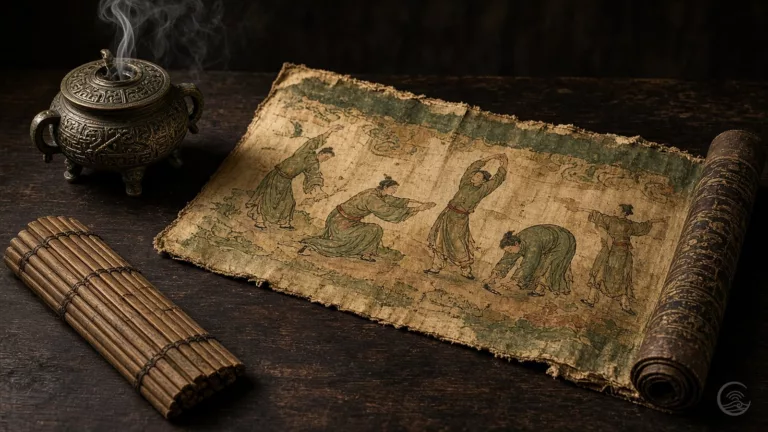
Daoyin (导引), “guiding and pulling”, is the old Chinese name for exercises that combine stretching, movement and breathing. Our article Daoyin: from the Mawangdui chart to modern Qigong follows it from the Zhuangzi, through a painted chart sealed in a tomb in 168 BCE and a bamboo manual of about 186 BCE, to the Qigong of the 1950s.
Zhang placed his work in this tradition by name. His 2004 textbook opens with a section on the history of daoyin [13]. In an essay on the Center’s website, he explains the first movement of his Health Qigong form through the Book of Changes, the old Chinese dictionary Shuowen jiezi and classical poetry [8]. The movement names are classical images, such as “The old steed in the stable” (老骥伏枥) [7].
But the system is new. The sources describe it as Zhang’s own creation from the 1970s, built from his reading of the classics, his training in wushu and Chinese medical theory [2, 3, 4, 6]. The German association adds that he came from a family of doctors and drew on exercise methods handed down in his family [3]; we found no other source for the family exercises. We found no source that traces any of his routines, movement for movement, to a specific ancient text. So Daoyin Yangsheng Gong is best seen as a modern system that uses the language and ideas of classical daoyin, not a reconstruction of an old form.
His part in Health Qigong
In 2001 China’s sport administration founded the Health Qigong Management Center, which compiled four standard forms in 2001–2003. Our article Health Qigong: how China’s standard forms were made tells that story. The Center’s notice naming the main leaders of the four teams lists Yang Bailong, Yu Dinghai, Shi Aiqiao and Zhang Mingliang, not Zhang Guangde [18], and we found no source that credits him with work on those first four forms.
His documented role came with the next round. In May 2009 the Center reported that five new forms were being compiled as research projects at four universities, including Beijing Sport University; one of them was the Twelve Daoyin Exercises (导引养生十二法) [9]. The Center’s introduction to the finished form calls it Health Qigong · Daoyin Yangsheng Gong Shi’er Fa. It says Beijing Sport University carried out the research, and that the form took 12 movements from the more than 50 routines Zhang had created since 1974 [6]. Zhang himself wrote about “compiling, practising and teaching” it [8]. The Center’s notice on his death names this form, the Health Qigong textbook series he helped write, and the training of Health Qigong specialists as his main contributions [1].
The form’s first movement is “Qianyuan qiyun” and its twelfth is “Qixi guiyuan”, “breath returns to the source” [7]. It is on the Center’s 2020 list of officially promoted forms and still on the updated list of 2026 [10, 11]. Most of Zhang’s other routines, including Shujin Zhuanggu Gong, are not on those lists [10, 11].
What science says
Label for this section: 🟡 Early evidence (research on single routines) · 📜 Documented history (Zhang’s role in research).
His place in research. Zhang made Daoyin Yangsheng Gong a university subject, with courses, master’s students and a research base. His university’s teaching section also houses a Health Qigong research base of the sport administration [4]. The Center’s notice on his death mentions “many scientific and technical research projects” [1]. The 1992 award was a prize for sports science and technology [4]; it was not an independent clinical evaluation. Scholars have also begun to study Zhang himself: the 2023 article mentioned above traces how his ideas developed over three periods, from 1932 to 2014 [5].
Trials of his routines. We searched PubMed. No trials were indexed under the name “Daoyin Yangsheng Gong”, but some appear under the names of single routines. A 2025 network meta-analysis compared six Chinese mind-body exercises in 49 small randomised trials of middle-aged and older people with high blood pressure [15]. It included three trials of Shuxin Pingxue Gong, one of the routines of Zhang’s Daoyin Yangsheng Gong [4], with 68 people in the exercise groups. These three trials measured blood pressure and compared practice with usual care or no structured exercise. The authors rated the certainty of the evidence for Shuxin Pingxue Gong as low, and noted that most trials were done in China and that few followed people up over a longer time [15]. Reviews also use the term “Daoyinyangshengshu”, but we could not tell which practice was meant, so we leave those results out. On the ladder in our article Study types explained: from anecdote to meta-analysis, this is early evidence: a few small trials, with nothing yet on the system as a whole.
If you have a health condition, please start with Who should be careful with breathing practices.
Where popular claims go beyond the evidence
Label for this section: 🟠 Speculative.
“Zhang cured his cancer with Qigong.” This is the account of his students and promoters [3, 16, 17]. We cannot check the diagnosis or the course of his illness, and a single recovery cannot show what caused it.
“Daoyin Yangsheng Gong is an ancient form.” It is a modern system, created from the 1970s onwards [4, 6]. It uses the language of classical daoyin, but we found no source tracing it to a specific old form.
“Zhang created the Health Qigong forms.” He is documented as the source of one of them, the Twelve Daoyin Exercises, whose compilation began by 2009 [6, 9]. The first four forms of 2001–2003 were compiled by teams led by others [18].
“Official recognition means it is proven to work.” The 1992 award and the 1996 National Fitness Programme listing are decisions by sport bodies [4], not independent clinical evaluations. The research on single routines is still early [15].
How this relates to the Six Healing Sounds, Qigong and neigong
Label for this section: 🔵 Tradition only (traditional theory) · 📜 Documented history.
Zhang’s work sits where the two lines of modern Qigong meet: the personal method of one teacher, and the official forms of the sport administration. Like Liu Zi Jue, his exercises link breathing and movement to the organs of traditional Chinese medicine. These organ links are traditional theory, not anatomy; our article Liu Zi Jue: where the Six Healing Sounds come from shows how such pairings changed over the centuries.
How I relate to Zhang Guangde’s work. I learned several routines from Zhang Guangde’s Daoyin Yangsheng Gong, including Shujin Zhuanggu Gong, a separate form from Yi Jin Jing, from my teacher Bob Lowey, who studied with Professor Zhang. I never studied with the Professor myself.
🟣 Lived experience (my own words and practice).
They are wonderful, fluid forms – opening the meridians and filling the body. No wonder that they are so very popular.
I often recall Bob talking very highly of the Professor’s work. The volume and quality of the Professor’s writing is mesmerising. I wish I had had the chance to meet him before his passing. He was a very special person.
I practise the Daoyin Poem (Xingti Shiyun, 形体诗韵 [23]) every day and believe it is one of the most beautiful and worthwhile forms there is, and one that is accessible to most practitioners. It was the first form I learned from Bob, and it remains close to my heart.
Resonance Heritage Qi is a personal, music-assisted practice inspired by Liu Zi Jue: connected to it, not a replacement for the traditional form or for study with a teacher of that tradition. If you want to learn Daoyin Yangsheng Gong properly, look for a qualified teacher of that system.
Enjoyed this article? Get my free practice guide to the Six Healing Sounds. Just sign up below, confirm your email, and it’s on its way.
Sources
- Health Qigong Management Center, General Administration of Sport of China, and Chinese Health Qigong Association, 2022. 我国著名健身气功专家张广德教授逝世 (Famous Health Qigong expert Professor Zhang Guangde has died), 30 January 2022. Official WeChat account, accessed 21 October 2026. https://mp.weixin.qq.com/s/aVHDUh9NNsQHfxBdVo5Yug
- Taijiquan & Qigong Journal, 2022. Prof. Zhang Guangde gestorben (Prof. Zhang Guangde has died), 7 February 2022, accessed 21 October 2026. https://tqj.de/prof-zhang-guangde-gestorben/
- Mehrtens L, for the board of the Daoyin Yangsheng Gong-Vereinigung Deutschland, 2022. Nachruf (Obituary of Professor Zhang Guangde), accessed 21 October 2026. http://www.dyysg.de/Nachruf_auf_Prof_Zhang_Guangde.pdf Mirror: https://www.wudang-bremen.de/assets/downloads/Nachruf_auf_Prof_Zhang_Guangde.pdf
- Beijing Sport University, China Wushu School, 2014. 导引养生教研室简介 (Introduction to the Daoyin Yangsheng teaching and research section), 28 May 2014, accessed 21 October 2026. https://wushu.bsu.edu.cn/xygk/jyssz/dyysjys/14372.htm ; archived copy: https://web.archive.org/web/2024/https://wushu.bsu.edu.cn/xygk/jyssz/dyysjys/14372.htm
- Han Xiaoming 韩晓明, Qiao Fengjie 乔凤杰, 2023. 张广德导引养生观的历史生成、要点阐析与时代价值研究 (Zhang Guangde’s view of daoyin health preservation: historical formation, core points and contemporary value). Journal of Beijing Sport University 46(2):139–148. Accessed 21 October 2026. Abstract: http://dianda.cqvip.com/Qikan/Article/Detail?id=00002HGKKH8O7JP0MJDO7JP16HR
- Health Qigong Management Center, 2012. 健身气功•导引养生功十二法简介 (Introduction to Health Qigong Daoyin Yangsheng Gong Shi’er Fa), 3 August 2012, accessed 21 October 2026. https://www.sport.gov.cn/qgzx/n5407/c670032/content.html
- Health Qigong Management Center, 2017. 健身气功•导引养生功十二法口诀 (Verse summary of Health Qigong Daoyin Yangsheng Gong Shi’er Fa), 7 September 2017, accessed 21 October 2026. https://www.sport.gov.cn/qgzx/n5407/c824761/content.html
- Zhang Guangde 张广德, 2017. “乾元启运”文化内涵解诂 (The cultural meaning of the movement “Qianyuan qiyun”). Health Qigong Management Center, 4 May 2017, accessed 21 October 2026. https://www.sport.gov.cn/qgzx/n5407/c801424/content.html
- Health Qigong Management Center, 2009. 五种健身气功新功法正在编创中 (Five new Health Qigong forms being compiled; news, 26 May 2009), accessed 21 October 2026. https://www.sport.gov.cn/qgzx/n5401/c666432/content.html
- Health Qigong Management Center, 2020. 体育总局气功中心关于健身气功推广功法目录的公告 (Notice on the list of promoted Health Qigong forms, 气功字〔2020〕51号), published 24 July 2020, accessed 21 October 2026. https://www.sport.gov.cn/qgzx/n5402/c957402/content.html
- Jia Haihong 贾海红, 2026. 清单做”加法”,服务做实事——健身气功新版功法目录发布 (New list of Health Qigong forms published). China Sports Daily, republished by the General Administration of Sport of China, 28 August 2026, accessed 21 October 2026. https://www.sport.gov.cn/n20001280/n20001265/n20067533/c29891430/content.html
- Zhang Guangde 张广德, 2003. 导引养生功标准教程(基础篇) (Daoyin Yangsheng Gong standard course: basic level). Beijing: Beijing Sport University Press. ISBN 978-7-81051-544-3.
- Zhang Guangde 张广德, 2004. 导引养生功 (Daoyin Yangsheng Gong). Beijing: Beijing Sport University Press. ISBN 978-7-81051-635-8. Contents as given in the publisher’s description; we have not seen the book.
- Zhang Guangde, 2015. Eight Movements to Make the Tendons and Muscles Supple, Strengthen the Bones: Shu Jin Zhuang Gu Gong, 1st Form. Translated by Zhu Mian Sheng and Mark Atkinson; commentary by André Perret. London and Philadelphia: Singing Dragon. ISBN 978-1-84819-252-2.
- Li H, Lin X, Wu X, Huang R, 2025. Effects of six traditional Chinese mind-body exercises on obesity and cardiovascular risk factors in middle-aged and elderly hypertensive patients: a network meta-analysis of 49 RCTs. BMC Cardiovascular Disorders 25:606. https://doi.org/10.1186/s12872-025-05084-x
- Yang Shiqiang 杨世强, 2018–2023. 张广德教授简介 and 缅怀恩师 (Professor Zhang Guangde: a profile; Remembering a revered teacher). 太極韻 (dyysg123.com), accessed 21 October 2026. https://www.dyysg123.com/24352241912450325945254803161620171.html
- Tai Chi Australia, 2024. Zhang Guangde, 16 December 2024, accessed 21 October 2026. https://www.taichiaustralia.com.au/post/zhang-guangde
- Health Qigong Management Center, General Administration of Sport of China, 2009. 关于举办健身气功社会培训班的补充通知 (Supplementary notice on public training courses in Health Qigong), dated 21 May 2009, accessed 21 October 2026. https://www.sport.gov.cn/qgzx/n5402/c665834/content.html
- Chinese Wushu Association, 2013. 关于批准牛怀禄等102人晋升高段位的通知 (Notice approving the promotion of Niu Huailu and 101 others to high duan grades), 18 November 2013. Republished by 中国太极拳网, 4 December 2013, accessed 21 October 2026. http://www.cntjq.net/gov/14591.html
- General Administration of Sport of China, 2014. 首批健身气功高段位套段名单正式出炉 (First list of high Health Qigong duan grades announced), 19 August 2014, accessed 21 October 2026. https://www.sport.gov.cn/n20001280/n20745751/n20767239/c21844833/content.html
- Beijing Sport University, China Wushu School, 2024. 张广德教授及夫人铜像落成仪式在八达岭陵园举行 (Unveiling ceremony of the bronze statue of Professor Zhang Guangde and his wife held at Badaling Cemetery), 15 April 2024, accessed 21 October 2026. https://wushu.bsu.edu.cn/xygk/1a3d15476ec748dc911541b54eec3093.htm
- Badaling Cemetery (八达岭陵园), 2024. 著名健身气功专家张广德教授及夫人长眠于八达岭陵园 (Famous Health Qigong expert Professor Zhang Guangde and his wife rest at Badaling Cemetery), 21 April 2024, accessed 21 October 2026. http://bdlly.com/xinwenzhongxin/2547.html
- Zhang Guangde (张广德), 2006. 導引養生形體詩韻 (Daoyin Yangsheng Xingti Shiyun), with VCD. Taipei: Dazhan (大展), 79 pp. ISBN 978-957-468-458-8. Author note (“中華武林百傑”) and contents as given in the publisher’s listing; we have not seen the book. https://www.ncc.com.tw/books/goods.php?id=11678
- Wushu World 武术世界网. 中华武林百杰 (list of the first national selection, announced December 1995), accessed 21 October 2026. http://www.21wushu.com/ReadNews.asp?newsID=9400
Source quality note:
- [1], [6]–[11] and [18] are published by the Health Qigong Management Center or the General Administration of Sport, or republished by them; [4] is Beijing Sport University’s own page. [19] and [20] are official records of his duan grades; [20] is on the General Administration of Sport’s site, and [19], a Chinese Wushu Association notice, was read as republished on a third-party site. They are official, insider sources: good for dates, names and stated roles, not independent assessments. [8] is written by Zhang himself.
- [2] is a German specialist magazine. [3], [16] and [17] are written by Zhang’s students or by associations and schools that teach his system. We use them for biographical details and for the story of his illness, and say so in the text; several of their details differ from each other.
- [5] is a peer-reviewed Chinese journal article; we have read its abstract only. [12]–[14] are Zhang’s own books; we have checked their bibliographic details but not read them. [12] is cited for its author note as reproduced online, and [13] for its contents as described by the publisher.
- [15] is a peer-reviewed network meta-analysis, checked in PubMed and read in full on PubMed Central.
- [21] is Beijing Sport University’s own news report; [22] is the cemetery operator’s own page, a commercial source, cited only for where the couple rest.
- All Chinese sources were read in the original on the pages linked; the translations are our own working translations. The section on my own practice draws on the Forms section of the main site.
Disclaimer
This article is for general education only. It is not medical advice and does not replace diagnosis or treatment by a doctor or other qualified health professional. Qigong and the Six Healing Sounds are traditional practices; we make no claims that they cure, treat or prevent any illness. If you have a health condition, are pregnant, or are unsure whether a practice suits you, please talk to your doctor first.