432 Hz vs 440 Hz: history, myths and evidence
Evidence label: Speculative
The history sections describe documented facts; the Speculative label applies to the health claims about 432 Hz.
In short
- What this is: 440 Hz is the international reference pitch for the note A above middle C, agreed in 1939 and set as an ISO standard. 432 Hz is a slightly lower alternative, about a third of a semitone flatter, that is popular online.
- What the evidence says: The history is well documented, but claims that 432 Hz is more “natural” or better for health rest on a handful of studies, mostly small pilots, with mixed results, so they remain speculative.
- What it means for your practice: Tune to whatever sounds and feels right for your voice, instruments and group. Choosing 432 or 440 Hz is a musical decision, not a health decision.
Background
Pitch used to wander. For most of Western music history there was no fixed A. Organ pitch in Germany before 1600 is thought to have ranged from about 377 Hz to 567 Hz, and Handel and Mozart are associated with an A of roughly 422–423 Hz [1]. In the 19th century, larger halls and brighter wind instruments pushed pitch up to around 450 Hz, straining singers’ voices. France fixed A at 435 Hz by law in 1859, and Britain recognised 439 Hz in 1896 [1].
Verdi and 432. “Verdi tuning” has a modest historical basis. Musicologist Ellen Lockhart describes how Giuseppe Verdi supported the French 435 Hz in the 1870s and later voiced a slight preference for 432 Hz because it was more comfortable for singers [2]. He sent his librettist Arrigo Boito to argue for 432 Hz at an Italian musicians’ congress in Milan in 1881, and an 1884 decree of the Italian War Ministry prescribed 432 Hz for all orchestral and military ensembles. The figure came from Charles Meerens, who liked it because it gave whole numbers across the keyboard. Verdi’s own arguments were about standardisation and singers: why, he asked in an 1884 letter, should the note called A in Paris or Milan become a B-flat in Rome? [2] But in 1885, before Italy could adopt 432 Hz nationally, a congress in Vienna backed 435 Hz [2].
How 440 Hz won. In the 1930s, radio made the problem obvious: broadcasters were exchanging concerts between countries tuned to different pitches [3]. On 11–12 May 1939, an international conference met at the BBC’s Broadcasting House in London, organised by the British Standards Institution under the International Standards Association. France, Germany, Great Britain, the Netherlands and Italy sent delegates, and the views of Switzerland and the United States were also considered [4]. The conference endorsed 440 Hz for the A in the treble stave [5]. The BBC generated its tuning note electronically, which is easy for 440 but not for 439, a prime number; whether this influenced the choice is unclear [1].
The Second World War interrupted the process. After a further London conference in 1953, the International Organization for Standardization issued Recommendation R 16 in 1955; 17 member bodies approved it and none voted against [5]. In 1975 it became the standard ISO 16, which sets A at 440 Hz with a tuning accuracy of 0.5 Hz. ISO last confirmed it in 2022 [6]. In practice, musicians do not always stick to it exactly; one mid-century account describes New York orchestras drifting to about 444 Hz [1].
What science says
The 2019 study below began by noting that no scientific studies supported the 432 Hz claims. What we found since then:
- Calamassi & Pomponi, 2019 [7]: 33 healthy volunteers listened to the same film soundtracks for 20 minutes, tuned to 440 Hz one day and 432 Hz on another. With 432 Hz, average heart rate was about 4.8 beats per minute lower (p = 0.05, right at the usual significance threshold). Blood pressure and breathing differences were not statistically significant. Participants reported being more satisfied after the 432 Hz sessions. The authors called it a pilot study and asked for larger randomised trials.
- Calamassi et al., 2020 [8]: 12 patients with spinal cord injuries listened to favourite music at each tuning. Sleep scores improved after the 432 Hz period, not after 440 Hz. Listening times and wash-out periods varied between participants.
- Calamassi et al., 2022 [9]: 54 emergency nurses during the COVID-19 pandemic. Anxiety scores fell in all three groups: 440 Hz music, 432 Hz music, and a break without music. The 432 Hz group also showed small drops in breathing rate and systolic blood pressure.
- Jebabli et al., 2025 [10]: 28 kickboxers warmed up to preferred music at about 440 Hz, about 432 Hz, or no music. Both music conditions beat silence, but performance and mood were best with 440 Hz.
- Zaki et al., 2025 [11]: 99 dental patients. 432 Hz music and binaural beats both reduced anxiety compared with white noise, equally. There was no 440 Hz group, so the study cannot tell us anything about tuning itself.
- Bozok et al., 2026 [12]: A larger 2026 trial compared 528 Hz and 432 Hz music with no music, but not with 440 Hz, and did not use tuning forks. 162 university students in Türkiye were randomly assigned to one of the three conditions for 20 minutes. With 432 Hz, one saliva marker (GRP78) was higher and another (BDNF) lower than with no music; Stroop test scores did not differ. No blinding is reported, the music is not described, and the abstract reports a BDNF rise with 528 Hz that the paper’s own Table 1 does not show. There was no 440 Hz group, so the study cannot tell us anything about tuning itself.
Why this is not enough. Most samples are small, three of the six studies come from one Italian research group, and many outcomes were measured, so some positive results can appear by chance. Where 440 Hz was compared directly, results point in different directions. Music in general often helped compared with silence or noise, but no study shows that the slightly lower tuning itself explains a lasting benefit.
Where popular claims go beyond the evidence
- “432 Hz is the natural frequency of the universe.” A hertz is one vibration per second, and the second is a human unit of time. If we measured time differently, the same note would have a different number. Number patterns built around 432 are numerology, not physics.
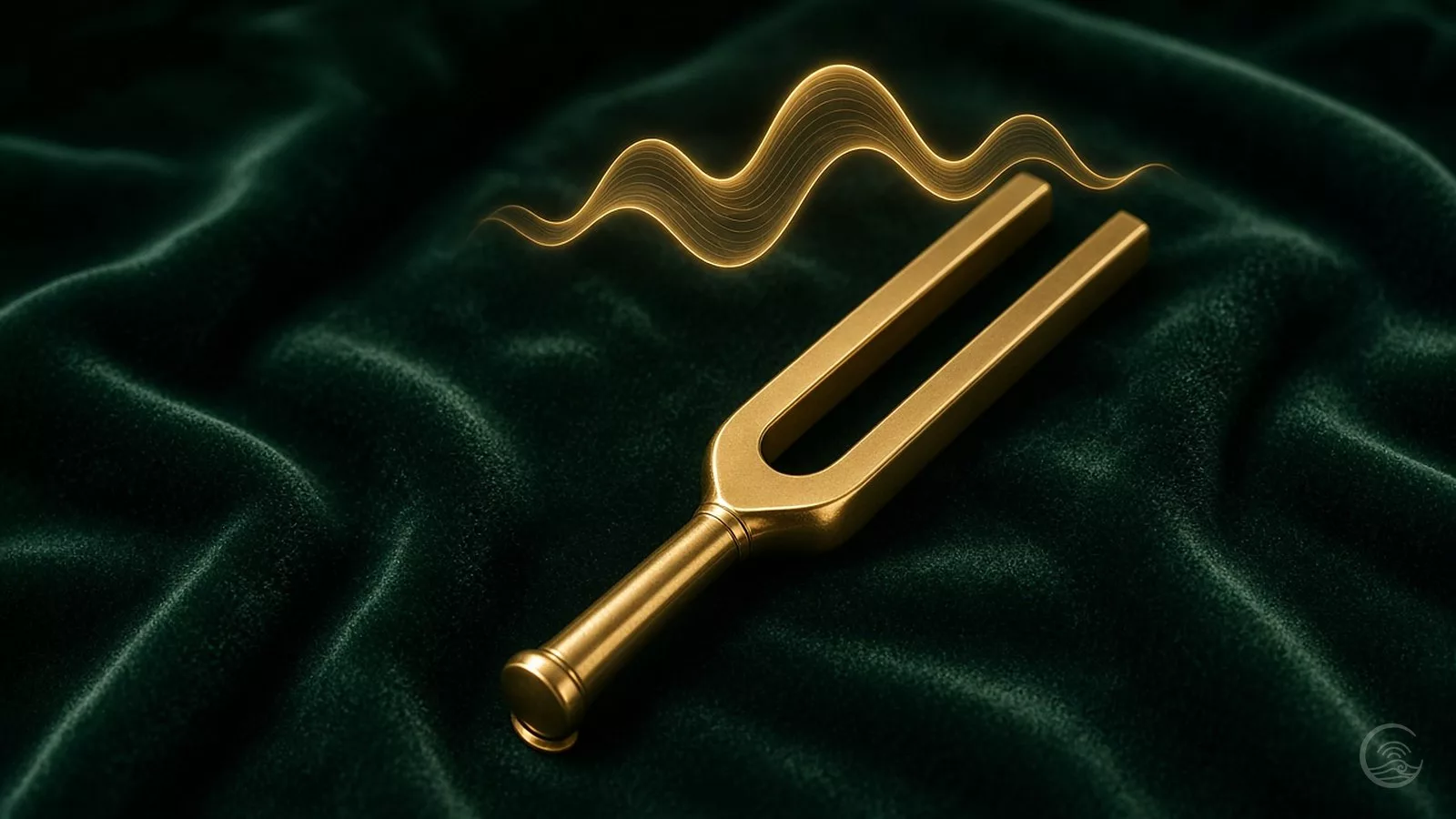
- “432 Hz resonates with your DNA.” Lockhart documents wellness products claiming that a 432 Hz fork makes “your atoms and DNA” resonate “in Harmony with the PHI spiral of nature” [2]. There is no scientific basis for this.
- “440 Hz was imposed for sinister reasons” (sometimes linked to the Nazis). The record shows a British-organised conference driven by broadcasting needs, later endorsed by ISO votes from many countries after the war [3–5]. Nothing in it supports a sinister origin. Lockhart notes that “Verdi tuning” as a modern cause was promoted from the late 1980s by the Schiller Institute [2].
- “Verdi said 432 Hz is healthy.” Verdi argued for a single international pitch and against straining singers’ voices. He made no claims about effects on listeners’ health [2].
How this relates to the Six Healing Sounds, Qigong and neigong
Label for this section: Tradition only (Qigong and neigong concepts) · Speculative (any claim that a tuning acts on the body or on qi).
There is no direct connection. Liu Zi Jue is far older than the idea of measuring pitch in hertz, and its traditional instructions concern the shape of each sound, the breath, movement and attention, not a frequency. Qigong and neigong traditions likewise work with breath, posture and inner attention. They do not prescribe a concert pitch.
You may hear that a certain tuning “harmonises qi” or suits energy work better. Qi is a traditional concept, and linking it to 432 or 440 Hz is a modern idea and, at most, a metaphor. The studies in this article measured heart rate, sleep, anxiety, saliva markers and performance, not qi, and their results were small and mixed [7–12].
Resonance Heritage Qi is a personal, music-assisted practice inspired by Liu Zi Jue: connected to it, not a replacement for the traditional form or for study with a teacher of that tradition. Where we use music, tuning forks or particular tones in sessions, these are aesthetic choices and an invitation to listen closely, not health claims. Claims about specific “healing frequencies” are covered in Solfeggio frequencies: where they come from and what the evidence says.
Try it gently (optional)
- Choose a calm piece of instrumental music and make two versions, one at standard pitch and one lowered to A = 432 Hz (many music apps can do this).
- Ask a friend to play them to you in random order without telling you which is which.
- Note which one you prefer, and why. Repeat on another day.
Whatever you notice is personal taste, which is a perfectly good reason to choose a tuning for your own music.
Enjoyed this article? Get my free practice guide to the Six Healing Sounds. Just sign up below, confirm your email, and it’s on its way.
Sources
- Cavanagh L, n.d. A brief history of the establishment of international standard pitch a=440 hertz. Essay (PDF), undated. https://www.wam.hr/sadrzaj/us/Cavanagh_440Hz.pdf
- Lockhart E, 2025. Tuning Sounds in Italy, 1750–1885. Nineteenth-Century Music Review 22(3):344–360 (published online 27 June 2025). https://doi.org/10.1017/S1479409824000375
- Kaye GWC, 1938. International Standard of Musical Pitch. Nature 142(3601):820–821. https://doi.org/10.1038/142820a0
- Kaye GWC, 1939. International Standard of Concert Pitch. Nature 143(3630):905–906. https://doi.org/10.1038/143905a0
- International Organization for Standardization, 1955. ISO Recommendation R 16: Standard tuning frequency (standard musical pitch), first edition, November 1955 (“Brief history” section). Preview: https://cdn.standards.iteh.ai/samples/51/8fc4068ddfcc4f628708d05d0aafd5b2/ISO-R-16-1955.pdf
- International Organization for Standardization, 1975. ISO 16:1975 Acoustics: Standard tuning frequency (Standard musical pitch). Confirmed 2022. https://www.iso.org/standard/3601.html
- Calamassi D, Pomponi GP, 2019. Music tuned to 440 Hz versus 432 Hz and the health effects: a double-blind cross-over pilot study. Explore (NY) 15(4):283–290. https://doi.org/10.1016/j.explore.2019.04.001 (corrigendum: Explore 2020;16(1):8, https://doi.org/10.1016/j.explore.2020.01.001)
- Calamassi D, Lucicesare A, Pomponi GP, Bambi S, 2020. Music tuned to 432 Hz versus music tuned to 440 Hz for improving sleep in patients with spinal cord injuries: a double-blind cross-over pilot study. Acta Biomedica 91(12-S):e2020008. https://doi.org/10.23750/abm.v91i12-S.10755 (PubMed: https://pubmed.ncbi.nlm.nih.gov/33263352/)
- Calamassi D, Li Vigni ML, Fumagalli C, Gheri F, Pomponi GP, Bambi S, 2022. The listening to music tuned to 440 Hz versus 432 Hz to reduce anxiety and stress in emergency nurses during the COVID-19 pandemic: a double-blind, randomized controlled pilot study. Acta Biomedica 93(S2):e2022149. https://doi.org/10.23750/abm.v93iS2.12915 (PubMed: https://pubmed.ncbi.nlm.nih.gov/35545982/)
- Jebabli N, Boujabli M, Khlifi M, Ouerghi N, Bouassida A, Ben Abderrahman A, van den Tillaar R, 2025. Effects of 440-Hz vs. 432-Hz preferred music frequencies, during warm-up, on intermittent anaerobic speed test performance in men and women kickboxers: a double-blind crossover study. PeerJ 13:e19084. https://doi.org/10.7717/peerj.19084
- Zaki H, Ahmed S, Rehman Qazi FU, Fatima N, Ali YS, 2025. Comparing binaural beats and 432 Hz music for reduction of preoperative anxiety in root canal patients: a randomized controlled trial. Journal of the Pakistan Medical Association 75(4):540–544. https://doi.org/10.47391/JPMA.21023
- Bozok ÜG, Özcan GB, Bayraktar B, Özen D, 2026. Acute music-frequency exposure modulates salivary stress and neurotrophic markers in young adults: a randomized controlled trial. Brain and Behavior 16(5):e71452. https://doi.org/10.1002/brb3.71452 (PubMed: https://pubmed.ncbi.nlm.nih.gov/42043979/)
Source quality note: The history rests on primary records (ISO documents, 1938–39 Nature reports) and musicological work. The health studies are pilot or single-centre trials, most of them small (12 to 162 participants), three of the six from one research group, with mixed results and no large independent replication.
Disclaimer
This article is for general education only. It is not medical advice and does not replace diagnosis or treatment by a doctor or other qualified health professional. Qigong and the Six Healing Sounds are traditional practices; we make no claims that they cure, treat or prevent any illness. If you have a health condition, are pregnant, or are unsure whether a practice suits you, please talk to your doctor first.