Tuning forks: from the doctor’s bag to the practice room
Evidence label: Well studied (how tuning forks vibrate and sound; their use in bedside tests, with known accuracy limits)
Evidence label: Speculative (therapeutic tuning-fork claims)
“Well studied” covers the physics of the fork and the research on how accurate clinical fork tests are, including where they fall short. The Speculative label covers claims that forks heal, tune or rebalance the body. Nothing in this article is a health claim.
Author: Raymond Hackland · Last reviewed: 21 October 2026 · Reading time: about 10 minutes
In short
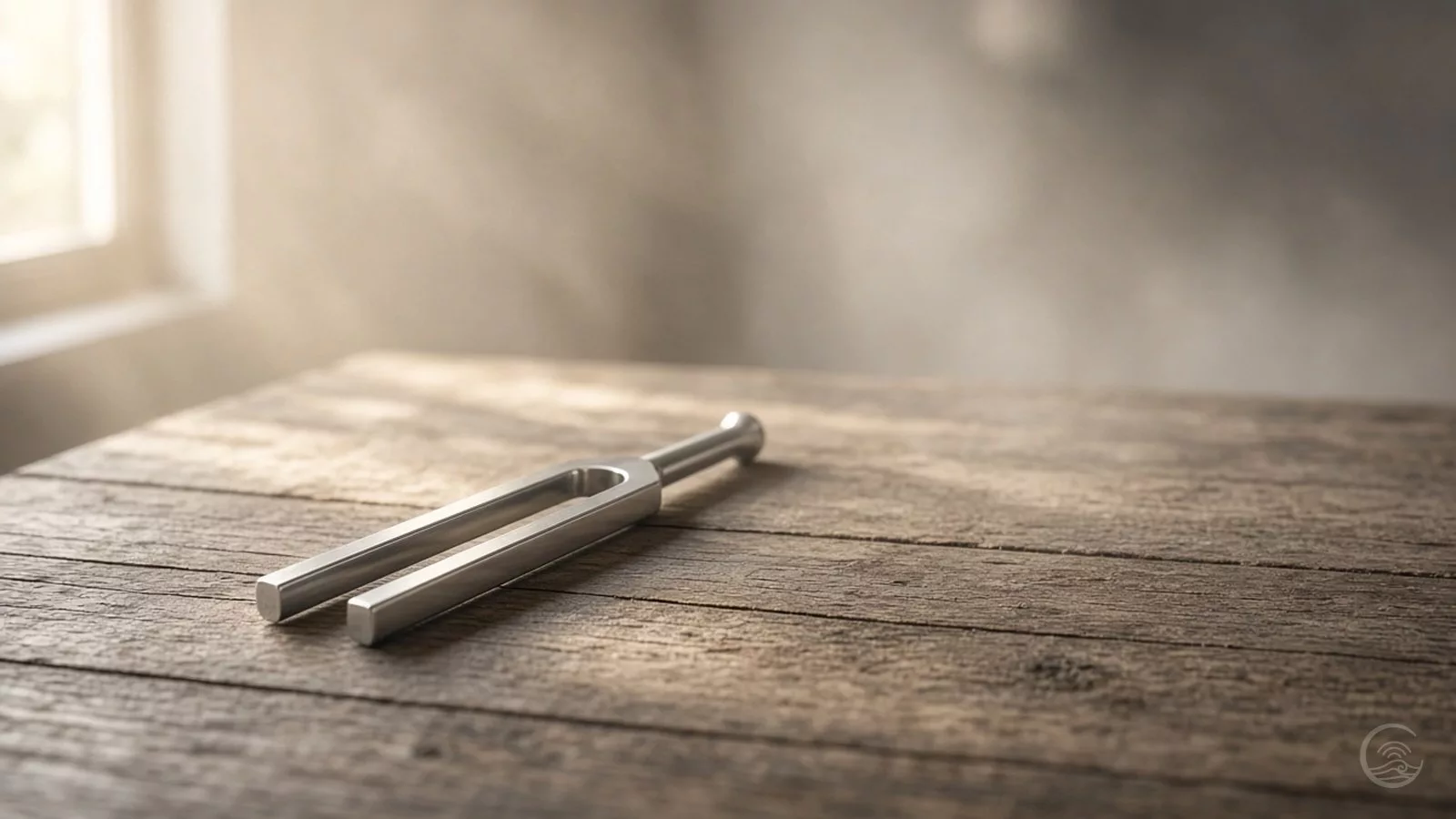
What this is: A tuning fork is a small piece of shaped steel that rings at one pitch. Musicians have used it for three centuries, doctors for nearly two, and today it also turns up in sound-healing kits and in my practice room. This article explains how a fork makes its tone, what clinicians actually use it for, and where claims about “tuning-fork therapy” part company with the evidence. It is part of our Music & Tone series, which starts with Music and stress: what 100+ trials show.
What the evidence says: A fork struck gently rings mainly at the single pitch stamped on it, and it sounds louder when its stem touches a table [1, 2]. Doctors use forks for quick bedside checks of hearing, and sometimes of vibration sense or possible fractures. Reviews show that these tests are useful but imperfect, and that their accuracy varies widely between studies [3–5]. Studies of forks as a therapy or for “energy-field” assessment are few and small, with no comparison group, mixed in with other methods, or run by people who train practitioners [6–8].
What it means for your practice: A fork is a reliable way to make a clear, steady pitch and to invite close listening. That is what it can honestly do. No study shows that a fork, or the frequency it is tuned to, acts on an organ or on qi.
What science says
Label for this section: 🟢 Well studied (fork acoustics; accuracy of clinical fork tests).
How a fork makes its tone
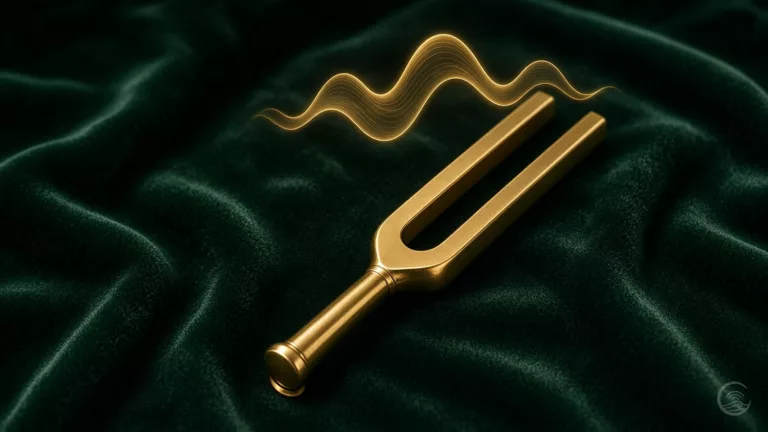
Strike a fork and its two prongs, called tines, swing towards and away from each other, each bending like a diving board fixed at the stem. This is the fork’s fundamental mode, and its frequency is the one stamped on the fork [2]. Because the two tines mirror each other, the stem seems to stay still, although, as the next section shows, it moves very slightly [2].
A fork can vibrate in other ways too [1, 2]. The best known is the “clang” mode: a bright, high ring at roughly six times the fundamental frequency (6.26 times for the fork modelled on the acoustics page of physicist Daniel Russell) [2]. You get it mostly by striking the tines against something hard [2]. The ear is more sensitive to these higher frequencies, so the clang can sound louder than the fundamental [2]. And when a fork is struck very hard, the tines no longer swing in a smooth curve, which adds overtones [1]. So the “almost pure” tone of a fork depends on how you strike it: a gentle tap on something soft gives the cleanest note. In one hearing study, for example, testers struck the tines against their own elbow [9].
Why it gets louder on a table
Hold a ringing fork in the air and it is fairly quiet. Touch its stem to a tabletop, a door or a piano and it sounds much louder. The reason is that the stem is not quite still. It moves up and down very slightly, at the fork’s frequency and at twice that frequency [1, 2]. The tabletop works as a soundboard: it picks up that small motion over a large surface. The physicists Rossing, Russell and Brown describe how touching the stem to a soundboard, or using a baffle, increases the strength of the fork as a sound source [1].
The tines also send sound out unevenly. Hold a ringing fork close to your ear and turn it slowly about its long axis, and you will hear four loud and four quiet positions in one full turn. At arm’s length you hear only two of each [10]. This is because the fork’s main mode radiates sound like what physicists call a linear quadrupole, a source that is loud in some directions and quiet in others [1, 10]. It is an easy experiment to try with any fork.
In the doctor’s bag: hearing tests
Doctors still carry forks because of a simple fact: you hear in two ways. Sound normally reaches the inner ear through the air, the eardrum and the tiny middle-ear bones. But vibration can also reach it directly through the bones of the skull, which is called bone conduction [11]. Comparing the two helps tell hearing loss in the outer or middle ear (conductive) from loss in the inner ear or nerve (sensorineural) [11].
Two classic bedside tests use this difference:
- Weber test. The stem of a ringing fork (256 or 512 Hz in the study cited here) is pressed to the middle of the forehead, and the person says whether they hear the tone in the left ear, the right ear or the middle of the head [9]. Where the sound seems to come from gives a clue to the kind of hearing loss [9].
- Rinne test. This compares how the same fork is heard through bone and through the air [12].
How accurate are they? A 2018 systematic review by Kelly and colleagues found 17 studies with 3,158 participants, adults and children [3]. For finding conductive hearing loss, the Rinne test detected between 43% and 91% of cases with a 256 Hz fork, and between 16% and 87% with a 512 Hz fork. How often it correctly cleared people without that loss also varied, from 50% to 100% and from 55% to 100% [3]. The point at which the Rinne test turned abnormal ranged from 13 to 40 decibels of conductive loss [3]. The studies used methods too different to pool, and most had a high risk of bias in how patients were selected [3]. A later study of 74 people with conductive hearing loss found that the fork Weber test pointed to the expected ear in about 81% to 85% of cases, close to the same test done with an audiometer’s bone vibrator [9].
So the forks are quick, cheap and genuinely useful, but they are a screening tool, not the final word. Today, bone conduction is mostly measured with calibrated audiometers, while fork tests remain a fast check at the bedside [11].
Other clinical uses: vibration and bone
- Vibration sense. A 128 Hz fork is one of the quick checks that guidelines recommend for nerve damage (neuropathy) in people with diabetes [4]. A 2021 review with meta-analyses found that two testers often disagree on this test: their agreement was only weak (a statistic called kappa was 0.42, where 1 means perfect agreement), and moderate when the same tester repeated it (0.54) [4].
- Fractures. Some clinicians place a fork on a bone to see whether it causes pain or whether sound travels poorly across a possible break. A 2014 systematic review of six small studies (329 patients) found that the tests caught 75% to 100% of fractures, but how often they correctly cleared people without a fracture ranged from 18% to 95% [5]. The authors concluded that fork tests “have some value in ruling out fractures, but are not sufficiently reliable or accurate for widespread clinical use” [5].
These are tests, not treatments. In each case the fork is used to make a controlled vibration and to find out something about the body. Nobody in these studies expected the fork to change anything.
How sure is all this?
- Solid: the physics of how forks vibrate and radiate sound, which has been measured and modelled in detail [1, 2, 10].
- Solid, with limits: fork tests are useful bedside checks, and their limits are well documented. Accuracy varies with the fork, the tester and the method [3–5, 9].
- Not tested here: none of these studies looked at forks as a relaxation or practice tool.
Our article Study types explained: from anecdote to meta-analysis explains what a systematic review can and can’t tell you.
What tradition says
Label for this section: 📜 Documented history.
The tuning fork has a history of its own, but it is not a Chinese one. It was invented in 1711 and soon became widely used in music. It was well over a century before physiologists and ear doctors took it up [13]. The 432 Hz article covers its role in setting concert pitch: 432 Hz vs 440 Hz: history, myths and evidence.
The medical story, as the medical historian Feldmann tells it in a German ear, nose and throat journal [13]:
- In 1834 the Leipzig anatomist and physiologist E. H. Weber described how bone-conducted sound seems to come from a blocked ear. Others had made the same observation seven years earlier, in 1827. None of them suggested a clinical use [13].
- In 1845 the Dresden ear doctor E. Schmalz brought the fork and the test later named after Weber into ear medicine, but his work went largely unnoticed [13].
- In 1855 A. Rinne, a physician in Göttingen, described the test that bears his name, mentioning its clinical use only in a footnote [13]. A historian of otology later found that Polansky had described the same test in 1842 [12]. It became widely known only after 1880 [12, 13].
- Doctors long found these tests unreliable, and better instruments followed: clamps to damp the overtones (1870), and by 1894 a set of ten forks with sliding clamps, two organ pipes and a whistle to cover the whole range of hearing. Charts of the results were early forerunners of today’s audiogram [14].
The fork entered medicine, in other words, as a way to measure hearing more exactly. Liu Zi Jue, by contrast, is a breathing and sound practice with roots in Chinese texts more than a thousand years old (see Liu Zi Jue: where the Six Healing Sounds come from). Tuning forks are not part of that tradition. In my practice they are a modern addition, which is why they are labelled here as history and personal practice, not as tradition.
Where popular claims go beyond the evidence
Label for this section: 🟠 Speculative.
- “A fork tuned to the right frequency tunes your organs, cells or DNA.” Forks make sound in the air and, through the stem, a small vibration in whatever they touch [1, 2]. Our article What resonance really is: from playground swings to singing bowls explains why soft, water-rich body tissue does not “resonate” with a chosen tone, and 432 Hz vs 440 Hz: history, myths and evidence describes products sold with this kind of claim.
- “Forks can find disturbances in your energy field.” In a 2020 study of a method called Biofield Tuning, three trained practitioners combed the space beside ten volunteers with a 174 Hz fork and noted where they sensed disturbances. They agreed poorly on where the disturbances were [6]. The researchers, one of whom works at the institute behind the method, reported this result openly [6].
- “Tuning-fork sound healing reduces anxiety.” A 2023 feasibility study gave 15 people with moderate to high anxiety scores three remote Biofield Tuning sessions; their questionnaire scores were lower afterwards [7]. There was no comparison group, so the change can’t be separated from expectation, attention or time. The authors included the founder of a company that trains the practitioners and of the institute that helped fund the study [7]. A 2026 randomised trial in 46 students combined singing bowls, tuning forks and a “magnetic” meridian massage and compared it with calming music or an audio story [8]. Because the forks were one part of a package, the trial can’t show what the forks did. The journal has since published a corrigendum (correction) to the article; we have not checked what it corrects [8].
- “Pressing a fork on an acupoint works like acupuncture.” In a PubMed search for this article, we found no trial testing it.
- “Special frequencies such as 528 Hz or 432 Hz make the fork work.” A few small pilot studies have compared the same music at two tunings: nine healthy adults heard piano music retuned so that 528 Hz falls in the scale, against standard 440 Hz [16], and 33 healthy volunteers heard film soundtracks at 432 Hz against 440 Hz [17]. Both used recorded music, not tuning forks, with tiny samples, one short listening session per tuning and no independent replication, so they cannot show that a particular frequency does anything special. See Solfeggio frequencies: where they come from and what the evidence says and 432 Hz vs 440 Hz: history, myths and evidence.
How this relates to the Six Healing Sounds, Qigong and neigong
Label for this section: 🟢 Well studied (fork acoustics, bone conduction) · 🟠 Speculative (any effect of a particular frequency on the body).
I use tuning forks in my immersions. The main site pairs each of the six sounds with a Solfeggio tone and says: “These are the frequency associations we use with tuning forks and music in the practice: an invitation to resonance, not a health claim” [15]. My immersions include “tuning forks, Solfeggio tones, live sound and curated instrumental playlists” [15]. Here is what the research above does and doesn’t say about that.
- A clear, steady pitch. A gently struck fork gives one of the cleanest, most stable tones you can make by hand [1, 2]. That makes it a good way to set a pitch and a mood at the start of a sound, and to invite close listening. The Solfeggio article explains why the choice of pitch is a musical one: Solfeggio frequencies: where they come from and what the evidence says.
- Fork and voice are different instruments. A fork’s tone is close to a single frequency. Your voice is rich in overtones, shaped by the mouth and throat. That is why SSSSS, HAAAA and the other sounds are so different from each other; see Vowels and formants: the acoustics of the six sounds.
- Feeling the vibration. A fork on bone can be heard through the skull, which is exactly what the Weber and Rinne tests use [9, 11]. How this applies to your own voice will be the subject of Feeling your own voice: bone conduction and chest vibration (coming soon). Neither fact means that the vibration reaches or changes an organ; that claim stays Speculative.
- Qi and the organs. The pairing of sounds with organs is traditional theory, not anatomy. Pairing them with fork frequencies is a modern, personal choice in my practice. No study has tested it.
From practice. 🟠 Speculative (any effect of a particular frequency). On the main site, I write about the Solfeggio tones: “I use them because I find them beautiful and helpful for setting a calm, focused mood. To be honest with you, there is little or no scientific evidence that these particular frequencies have special effects on the body” [15].
Both kinds of knowledge have their place. The physics explains why a fork sounds so clean and why a table makes it louder. Medicine shows a precise, limited use for it. The practice room gives the same small instrument a different job: to mark a beginning, set a tone and draw attention to listening. That job needs no health claim to be worth doing.
If you have a health condition, please read Who should be careful with breathing practices before you start.
Resonance Heritage Qi is a personal, music-assisted practice inspired by Liu Zi Jue: connected to it, not a replacement for the traditional form or for study with a teacher of that tradition. No study has tested it, and we make no claims about its effects. Where we use music, tuning forks or particular tones in sessions, these are aesthetic choices and an invitation to listen closely, not health claims. Claims about specific “healing frequencies” are covered in Solfeggio frequencies: where they come from and what the evidence says.
Enjoyed this article? Get my free practice guide to the Six Healing Sounds. Just sign up below, confirm your email, and it’s on its way.
Sources
- Rossing TD, Russell DA, Brown DE, 1992. On the acoustics of tuning forks. American Journal of Physics 60(7):620–626. https://doi.org/10.1119/1.17116
- Russell DA, 2012. Vibrational modes of a tuning fork. Acoustics and Vibration Animations, Graduate Program in Acoustics, The Pennsylvania State University, accessed 20 October 2026. https://www.acs.psu.edu/drussell/Demos/TuningFork/fork-modes.html
- Kelly EA, Li B, Adams ME, 2018. Diagnostic accuracy of tuning fork tests for hearing loss: a systematic review. Otolaryngology–Head and Neck Surgery 159(2):220–230. https://doi.org/10.1177/0194599818770405
- McIllhatton A, Lanting S, Lambkin D, Leigh L, Casey S, Chuter V, 2021. Reliability of recommended non-invasive chairside screening tests for diabetes-related peripheral neuropathy: a systematic review with meta-analyses. BMJ Open Diabetes Research & Care 9(2):e002528. https://doi.org/10.1136/bmjdrc-2021-002528
- Mugunthan K, Doust J, Kurz B, Glasziou P, 2014. Is there sufficient evidence for tuning fork tests in diagnosing fractures? A systematic review. BMJ Open 4(8):e005238. https://doi.org/10.1136/bmjopen-2014-005238
- Hammerschlag R, McKusick ED, Bat N, Muehsam DJ, McNames J, Jain S, 2020. Inter-rater agreement of Biofield Tuning: testing a novel health assessment procedure. Journal of Alternative and Complementary Medicine 26(10):911–917. https://doi.org/10.1089/acm.2020.0159
- Jain S, McKusick E, Ciccone L, Sprengel M, Ritenbaugh C, 2023. Sound healing reduces generalized anxiety during the pandemic: a feasibility study. Complementary Therapies in Medicine 74:102947. https://doi.org/10.1016/j.ctim.2023.102947
- Lam CY, Leung CLK, Li KK, 2026. Evaluating the sound magnetic balance intervention in a randomized controlled trial: effects on psychological distress, somatic pain, and physiological arousal. Explore (NY) 22(2):103323. https://doi.org/10.1016/j.explore.2026.103323 ; corrigendum: Explore (NY) 22(4):103427. https://doi.org/10.1016/j.explore.2026.103427
- Abdullah SN, Zakaria MN, Salim R, Md Daud MK, Nik Othman NA, 2022. Comparing the diagnostic accuracy of audiometric Weber test and tuning fork Weber test in patients with conductive hearing loss. Laryngoscope Investigative Otolaryngology 7(2):523–529. https://doi.org/10.1002/lio2.747
- Russell DA, 2000. On the sound field radiated by a tuning fork. American Journal of Physics 68(12):1139–1145. https://doi.org/10.1119/1.1286661
- Sutton AE, Winters R, 2026. Bone conduction evaluation. In: StatPearls. Treasure Island (FL): StatPearls Publishing, updated 8 September 2026. PMID 35201705. https://www.ncbi.nlm.nih.gov/books/NBK578177/
- Huizing EH, 1975. The early descriptions of the so-called tuning-fork tests of Weber, Rinne, Schwabach, and Bing. II. The “Rhine test” and its first description by Polansky (title as indexed in PubMed). ORL 37(2):88–91. https://doi.org/10.1159/000275210
- Feldmann H, 1997. Die Geschichte der Stimmgabel – Teil 2: Die Entwicklung der klassischen Versuche nach Weber, Rinne und Schwabach [History of the tuning fork. II: Evolution of the classical experiments by Weber, Rinne and Schwabach]. Laryngo-Rhino-Otologie 76(5):318–326. https://doi.org/10.1055/s-2007-997435
- Feldmann H, 1997. Die Geschichte der Stimmgabel – Teil 3: Auf dem Weg zur quantitativ messenden Tongehörsprüfung [History of the tuning fork. III: On the way to quantitative pure-tone measurement]. Laryngo-Rhino-Otologie 76(7):428–434. https://doi.org/10.1055/s-2007-997457
- Resonance Heritage Qi. Main website: “Practice”, “Immersions” and “The Science of Sound” sections, accessed 22 October 2026. https://resonanceheritageqi.com/
- Akimoto K, Hu A, Yamaguchi T, Kobayashi H, 2018. Effect of 528 Hz music on the endocrine system and autonomic nervous system. Health 10(9):1159–1170. https://doi.org/10.4236/health.2018.109088
- Calamassi D, Pomponi GP, 2019. Music tuned to 440 Hz versus 432 Hz and the health effects: a double-blind cross-over pilot study. Explore (NY) 15(4):283–290. https://doi.org/10.1016/j.explore.2019.04.001 ; corrigendum: Explore (NY) 16(1):8. https://doi.org/10.1016/j.explore.2020.01.001
Source quality note: [1] and [10] are peer-reviewed physics papers; we read their published abstracts, and the details of fork modes come from [2], an educational page by the co-author of [1] and author of [10], a university acoustics researcher. [3], [4] and [5] are peer-reviewed systematic reviews; [3] and [5] could not pool their studies, and [4] includes meta-analyses. [9] is a single peer-reviewed clinical study. [11] is a regularly updated, peer-reviewed clinical reference (StatPearls). [12]–[14] are peer-reviewed history-of-medicine papers; we read their abstracts only ([13] and [14] are in German). [6]–[8] are small peer-reviewed studies of fork-based therapies: [6] and [7] are by researchers linked to the method they tested, [7] had no comparison group, and [8] tested forks only as part of a package. [15] is our own website. [16] and [17] are small peer-reviewed pilot studies of recorded music at two tunings, not of tuning forks; we read the full text of [16] and the abstract of [17].
Disclaimer
This article is for general education only. It is not medical advice and does not replace diagnosis or treatment by a doctor or other qualified health professional. Qigong and the Six Healing Sounds are traditional practices; we make no claims that they cure, treat or prevent any illness. If you have a health condition, are pregnant, or are unsure whether a practice suits you, please talk to your doctor first.