Tempo, rhythm and breath, and the stillness between sounds
Evidence label: Early evidence
The Early evidence label covers a few small laboratory studies of breathing and circulation during music. Nothing here is a health claim.
Author: Raymond Hackland · Last reviewed: 21 October 2026 · Reading time: about 8 minutes
In short
What this is: Music has a pulse and so does breathing. This article asks whether the tempo of music changes how you breathe, and what happens to breath and heartbeat when the music stops. It is part of our Music & Tone series, which starts with Music and stress: what 100+ trials show.
What the evidence says: In small laboratory studies, breathing partly fell into step with a musical beat in about half of the listeners. Faster music raised breathing rate, heart rate and blood pressure, and during a two-minute silence inserted among the tracks, these measures were lower than before the music began. The studies are small, all with volunteers, and none tested the Six Healing Sounds.
What practice adds: In practice, you don’t just listen to tempo; you breathe and sound inside it, and the quiet in-breath after each sound is a pause you make yourself. That is a description of practice, not a research finding.
What it means for your practice: If you use music with the sounds, slow music that doesn’t push you is a reasonable musical choice, and the stillness after each sound is worth noticing. Neither is a treatment for anything.
Background
A musical tempo is counted in beats per minute. A slow piece might move at 55 to 70 beats a minute, fast dance music at 130 or more. Breathing is much slower: most people, most of the time, breathe about 9 to 24 times a minute, as our article “Slow breathing and heart rate variability” explains. So if breath and music are to “lock”, one breath has to span several beats.
Breathing is also two things at once. It runs automatically, and you can take it over at will. Singers, wind players and people who practise breathing exercises spend years learning to fit breath to phrase. The question here is narrower: when you simply listen, does the music move your breath, and does anything happen when it stops?
What science says
Label for this section: 🟡 Early evidence.
Does breathing follow the beat? In a study published in 1986, Haas, Distenfeld and Axen asked 20 people, 10 musically trained and 10 not, to tap along to a metronome and then to four pieces of music, five minutes each; ten of them also listened without tapping [1]. Breathing became more regular with music: the breath-to-breath variation fell from 23% at rest to 15% while listening and 10% while listening and tapping. In half of the participants, the length of each breath was significantly correlated with the musical rhythm, a loose form of coupling the authors call “relative entrainment”. In 12 people the researchers sometimes found tight coupling, a whole number of beats per breath, but not consistently in each person. The authors proposed that rhythm can act as a “zeitgeber”, a time-giver for breathing, and that tapping strengthens its signal [1]. We have read the abstract of this study, not the full paper.
Faster music, faster breathing. In a study published in 2006, Luciano Bernardi, Cesare Porta and Peter Sleight measured breathing, heart rate, blood pressure and blood flow in the brain while 24 young adults, 12 musicians and 12 non-musicians, lay with eyes closed and listened through headphones [2]. They were asked not to tap. Six styles were played, from slow (an Indian raga at about 55 beats a minute, the adagio of Beethoven’s Ninth Symphony at about 70) to fast (techno at about 136, a Vivaldi presto at about 150), first for two minutes each and then again for four. Faster tempi raised breathing rate, ventilation, blood pressure and heart rate; slower music changed them less. Style mattered less than speed: fast classical music and techno had similar effects, and the slow pieces had similar effects to each other. Liking a piece made no difference to the measurements, and the effects did not wear off when the music was repeated. Musicians’ breathing was more sensitive to tempo than non-musicians’ [2].
There were hints of entrainment here too. In the slowest pieces, participants took roughly one breath for every four beats, and in the fastest roughly one for every eight; at the in-between tempi there was no such pattern. The authors leave open whether music changes breathing directly or raises general arousal, which in turn speeds breathing, and suggest that both may happen together [2]. The paper does not give breathing rates for each piece as numbers, but its figures show that even during the slowest piece average breathing stayed close to the resting baseline, at roughly 14 to 15 breaths a minute (our reading of their Figure 1), nowhere near the six breaths a minute discussed in our slow-breathing article. In the authors’ words, slow meditative music “had no significant effect on respiration and blood pressure” [2]. Fast music sped breathing up; slow music did not, on its own, slow it down.
The importance of silence. The subtitle of Bernardi’s paper is “the importance of silence”. Into the sequence of tracks, the researchers inserted two minutes of silence at a random point. During that pause, heart rate, blood pressure and minute ventilation were on average lower than at the baseline measured before any music had been played [2]. During the slowest piece, the raga, heart rate was also significantly lower than at baseline, but it was lowest during the pause [2]. The authors call this relaxation and write that music may “first concentrate attention during faster rhythms, then induce relaxation during pauses or slower rhythms” [2]. In the authors’ own words, it was “precisely during this short intermission, rather than during music” that they saw “the greatest evidence of relaxation” [2].
Following the shape of the music. In a second study, Bernardi’s group played 24 young adults (12 choir singers, 12 non-musicians) music with gradual crescendos (Puccini, the adagio from Beethoven’s Ninth), music with more even emphasis (a Bach cantata), and two Verdi arias whose phrases repeat about every ten seconds [3]. Blood pressure and the narrowing of small skin vessels rose and fell with the crescendos, and the even music went with the opposite. During the ten-second phrases, cardiovascular rhythms fell into step with the music. Ten seconds is the same rhythm as six breaths a minute, at which our slow-breathing article describes heart and breath swinging most strongly together. This time musicians and non-musicians responded in qualitatively the same way [3]. We have read this study’s abstract only; the full text was not available to us.
How strong is this evidence? It is consistent but thin. Three studies, two from one research group, with 20 to 24 volunteers each (healthy young adults in the two Bernardi studies), listening in a laboratory for a few minutes at a time. Breathing, heart rate and blood pressure were measured, not health. The pause in [2] was a single two-minute silence, not the few seconds between sounds in practice. And none of these studies tested Liu Zi Jue, Qigong or anyone making sound themselves: the participants listened (and in [1] also tapped along). That is why this article carries the 🟡 Early evidence label. For how to weigh small studies like these, see “How to read a health study in 5 minutes”.
What practice notices
Label for this section: 🟡 Early evidence (the studies above, which did not test the sounds).
The laboratory and the practice room ask different questions. In the studies, people lay still and listened; the music came from outside and the researchers chose when it stopped. In the Six Healing Sounds you stand, move and make the sound yourself. The breath is not following the music; it carries the sound, and the music, if there is any, accompanies it. The pause is not inserted by a researcher; it is the quiet in-breath you take after each sound, and the moment of stillness before the next one.
Because of that difference, three questions come up in practice that the studies above did not ask:
- Does the tempo of the music pull at the breath? The 2006 study suggests that fast music can push breathing faster even when you are only listening [2].
- What is the stillness after a sound like? The “importance of silence” finding is about the measurable body during a pause. What people notice in the pause after a sound (how long it lasts, what the attention does, whether the next breath comes by itself) has not been studied.
- Does it matter whether the sound is voiced or nearly silent? Breathing out on a voiced sound and on an almost silent one may feel quite different, but no study we know of compares them for tempo or pause.
If good research appears on these questions, we will add it and review the label.
My main website describes how I use music: my immersions combine the sounds with “curated instrumental music”, “sequenced instrumental music”, tuning forks and live sound [4].
Where popular claims go beyond the evidence
“Music at 60 beats a minute synchronises your heart.” The studies here found that cardiovascular rhythms can follow musical phrases of about ten seconds [3] and that breathing loosely follows the beat in some listeners [1]. That is not the same as the heart locking to a beat, and none of the studies used 60 beats a minute as a target.
“Slow music slows your breathing down to the ideal rate.” In [2], breathing during even the slowest track stayed close to the resting rate; the authors write that slow meditative music had “no significant effect on respiration” [2]. If you want to breathe slowly, it is the breathing itself that does it, as our article “Slow breathing and heart rate variability” explains.
“Silence heals.” During the two-minute pause in [2], heart rate, blood pressure and ventilation in 24 healthy young adults were on average lower than at baseline. The authors speculate that music may give pleasure “(and perhaps a health benefit)” through “this controlled alternation between arousal and relaxation” [2]; their own word is “perhaps”. A short drop in these measures in a laboratory is not a treatment for anything.
“Your breath should match the beat.” Nothing in these studies says that matching breath to beat is better. They describe what happened when people listened. In breath-led practice, the music is there to accompany the breath, not to set it.
How this relates to the Six Healing Sounds, Qigong and neigong
Label for this section: 🔵 Tradition only (Qigong and neigong concepts) · 🟡 Early evidence (the studies above), with my own approach marked as mine.
Liu Zi Jue is a breathing practice before it is a musical one. The traditional instructions concern the shape of each sound, the breath, movement and attention, not a tempo; you can read about where they come from in “Liu Zi Jue: where the Six Healing Sounds come from”. Each sound (SSSSS, CHOOO, SHHHH, HAAAA, WHOOO, HEEE) is carried on a long, unhurried exhalation and followed by a quiet in-breath through the nose. Whether a session reaches the slow range described in our slow-breathing article depends on your own pace, not on the music.
The stillness between sounds also has a place in the internal traditions, where quiet standing and sitting are practices in their own right; see “Stillness and posture: sitting and standing practice in the internal traditions”. That is a traditional framing, not a physiological one. The “importance of silence” finding sits beside it, but it does not explain it, and none of the studies measured qi.
How I practise the sounds. My practice is breath-led: you breathe in quietly through the nose and breathe the six sounds out through the mouth, “voiced through the breath”, not sung, working over time towards a silent exhalation. The breathing stays slow and controlled throughout, with no breath holds and no fast breathing. In my immersions we practise the sounds standing, in the wuji posture (无极, “without limit”), for those who are able to stand comfortably. Neidan is not part of my immersions; we use neigong and visualisation.
If you have a health condition, read “Who should be careful with breathing practices” first.
Resonance Heritage Qi is a personal, music-assisted practice inspired by Liu Zi Jue: connected to it, not a replacement for the traditional form or for study with a teacher of that tradition. No study has tested it, and we make no claims about its effects. Where we use music, tuning forks or particular tones in sessions, these are aesthetic choices and an invitation to listen closely, not health claims. Claims about specific “healing frequencies” are covered in “Solfeggio frequencies: where they come from and what the evidence says”, and tuning in “432 Hz vs 440 Hz”.
Try it gently (optional)
- Choose two instrumental pieces you like: one slow, with little or no beat, and one clearly faster.
- Sit or stand comfortably and listen to each for three minutes, without trying to change your breathing. Afterwards, simply note whether your breath felt pulled along, and by which piece.
- Then sit for two minutes in silence and notice what the quiet is like.
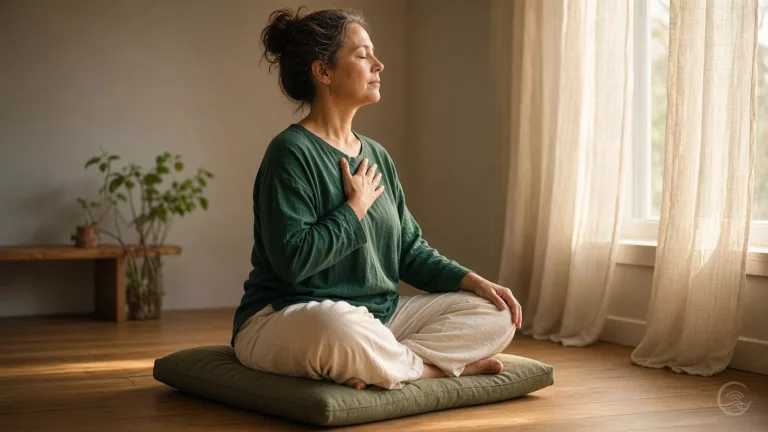
- On another day, practise one of the six sounds a few times without music. After each sound, let the in-breath come quietly through the nose and rest for a moment before the next. Notice the stillness, not as a target, just as it is.
Whatever you notice is your own experience. Never force your breath. If you feel dizzy, lightheaded or short of breath, stop and breathe normally.
Enjoyed this article? Get my free practice guide to the Six Healing Sounds. Just sign up below, confirm your email, and it’s on its way.
Sources
- Haas F, Distenfeld S, Axen K, 1986. Effects of perceived musical rhythm on respiratory pattern. Journal of Applied Physiology 61(3):1185–1191. https://doi.org/10.1152/jappl.1986.61.3.1185 (PubMed: https://pubmed.ncbi.nlm.nih.gov/3759758/)
- Bernardi L, Porta C, Sleight P, 2006. Cardiovascular, cerebrovascular, and respiratory changes induced by different types of music in musicians and non-musicians: the importance of silence. Heart 92(4):445–452 (published online 30 September 2005). https://doi.org/10.1136/hrt.2005.064600 (full text: https://pmc.ncbi.nlm.nih.gov/articles/PMC1860846/)
- Bernardi L, Porta C, Casucci G, Balsamo R, Bernardi NF, Fogari R, Sleight P, 2009. Dynamic interactions between musical, cardiovascular, and cerebral rhythms in humans. Circulation 119(25):3171–3180. https://doi.org/10.1161/CIRCULATIONAHA.108.806174 (PubMed: https://pubmed.ncbi.nlm.nih.gov/19569263/)
- Resonance Heritage Qi, main website: immersion description (“What the seven days contain”, “Each session moves through”, “A living lineage”). Accessed 20 October 2026. https://resonanceheritageqi.com/
Source quality note: [1]–[3] are peer-reviewed laboratory studies in small groups of volunteers (20 to 24 people each), two of them from one research group. We read [2] in full; for [1] and [3] we read the abstracts only. [4] is our own main website and is cited only for how my sessions are described, not as evidence of any effect.
Disclaimer
This article is for general education only. It is not medical advice and does not replace diagnosis or treatment by a doctor or other qualified health professional. Qigong and the Six Healing Sounds are traditional practices; we make no claims that they cure, treat or prevent any illness. If you have a health condition, are pregnant, or are unsure whether a practice suits you, please talk to your doctor first.