Solfeggio frequencies: where they come from and what the evidence says
Evidence label: Speculative
The two history sections describe documented facts; the Speculative label applies to the health claims made for these frequencies.
In short
- What this is: “Solfeggio frequencies” are a set of tones (396, 417, 528, 639, 741 and 852 Hz, often extended to nine) popular in sound-healing music. They borrow the name of the medieval singing syllables ut-re-mi-fa-sol-la, but the numbers were first published in 1999.
- What the evidence says: A handful of studies exist, mostly small and mostly on 528 Hz, and none can separate an effect of the frequency from the effect of simply listening to music; health claims such as “528 Hz repairs DNA” have no scientific support.
- What it means for your practice: You can enjoy these tones as a tuning and listening choice. They are not a technique with established health effects.
Background
The medieval syllables 📜 Documented history
In the 11th century, the Benedictine monk Guido d’Arezzo developed a way to help singers learn melodies faster. He used a Latin hymn to St John the Baptist, Ut queant laxis, whose first six lines each begin one step higher than the last. The syllables sung on those opening notes, ut, re, mi, fa, sol, la, became names for the six steps of a scale, called a hexachord [1, 2].
The point of the system was relationships, not fixed pitches. Mi to fa, for example, was always a half step, “no matter how high or low the two pitches were sung” [1]. In the 17th century ut became do and si (later ti) was added, giving the do-re-mi we know today [1]. No frequencies were attached to any of these syllables, and medieval musicians had no way to measure them: even in the 18th century, a leading theorist such as Tartini still had no means to count vibrations per second, and reliable measurement only became widespread in the 19th century [3].
The modern “Solfeggio frequencies” 📜 Documented history
The numbers come from a much more recent source: the book Healing Codes for the Biological Apocalypse by Leonard G. Horowitz and Joseph S. Puleo, published in 1999 [4]. The book presents the frequencies as the result of divine revelations to Puleo, described as a herbalist, whose story it traces back to the 1970s [4, 5].
According to the book, Puleo turned to chapter 7 of the biblical Book of Numbers, starting at verse 12, and reduced the verse numbers to single digits by adding their digits: verse 12 gives 1+2=3, verse 18 gives 1+8=9, verse 24 gives 2+4=6, and so on, producing a repeating 3-9-6 pattern [4]. The book calls this method the “Pythagorean skein”. It then lists six “secret Solfeggio frequencies” matched to the old syllables: Ut 396, Re 417, Mi 528, Fa 639, Sol 741, La 852. Each number’s digits add up to 9, 3 or 6 [4].
As a Science Feedback fact-check puts it, apart from the name, the two are unrelated [5]. The six numbers are also not a musical scale: the gaps between them (21, 111, 111, 102 and 111 Hz) do not match the intervals of any tuning system in use [5]. The 963 Hz tone found in many modern lists does not appear among the book’s six; the nine-tone set is a later extension.
What science says
Akimoto et al., 2018 [6]: Nine healthy adults in Japan listened for five minutes to soothing piano music, once in a version the authors call “528 Hz music” (tuned so that A = 444 Hz, which puts 528 Hz in the scale) and once at standard 440 Hz, on separate days. After the 528 Hz version, salivary cortisol fell and oxytocin rose significantly, and tension scores dropped. After 440 Hz, changes mostly went the same way but were not significant. The authors themselves write that the various effects ascribed to Solfeggio frequencies have no scientific basis.
Limitations: nine participants (eight for the heart data), only five minutes of listening, no reported randomisation of order, and the two versions were each compared with their own baseline rather than tested directly against each other. A result being significant in one condition but not the other does not show that the conditions differ.
Babayi & Riazi, 2017 [7]: Human astrocyte cells (a type of brain support cell) were damaged with ethanol in a dish and exposed to a 528 Hz tone. At 80 dB, cell death fell by about 18 to 20%; at 100 and 120 dB there was no comparable benefit. The controls were silence and switched-off speakers. Limitations: cells in a dish are not people, no other frequency was tested, so the study cannot show that 528 Hz is special, and its statement that 528 Hz activates DNA repair cites only Horowitz’s book [4].
Dos Santos et al., 2023 [8]: In zebrafish stressed by 24 hours of light, “Solfeggio-frequency music” reversed the resulting memory deficits and rise in cortisol. The authors interpret this as environmental enrichment through music. Limitations: an animal study, which cannot tell us what happens in people, and the abstract does not report a comparison with music at other tunings.
Recent human trials with 528 Hz in a package. A 2025 trial in 60 people with high blood pressure compared daily listening to an OM chant composed at 528 Hz with standard care alone [9]. A 2026 trial in 100 adults compared four weeks of in-person sound meditation (528 Hz audio plus singing bowls, gongs and bells) with remotely delivered music sessions; it was funded by a technology company [10]. Both reported benefits, but neither compared the same experience at another frequency, so neither can isolate 528 Hz.
Bozok et al., 2026 [11]: A larger 2026 trial compared 528 Hz and 432 Hz music with no music, but not with 440 Hz. 162 university students in Türkiye were randomly assigned to no music, “528 Hz” or “432 Hz” instrumental music for 20 minutes. Some saliva markers differed between the groups; scores on the Stroop test (an attention task) did not. Limitations: one session, no 440 Hz version, no reported blinding, and the music is not described, so it cannot show that the frequency rather than the piece made the difference. The abstract also claims more than the paper’s own Table 1: it reports that one marker (BDNF) rose with 528 Hz compared with no music, but the table shows no difference between the two.
Where popular claims go beyond the evidence
- “Ancient tones used by Gregorian monks.” The syllables are medieval; the frequencies are from 1999 [1, 4, 5].
- “528 Hz repairs DNA.” The book’s source for this is a personal communication with a “clustered water” inventor [4]. No study cited here tested DNA repair in people.
- “Special numbers mean special effects.” Digit sums depend on counting in base ten and measuring in seconds, both human conventions. They say nothing about how sound acts on the body.
- “Each frequency targets a specific problem.” We found no controlled study testing these assignments.
How this relates to the Six Healing Sounds, Qigong and neigong
A tuning choice, not an evidence claim
Label for this section: Tradition only (Qigong and neigong concepts) · Speculative (claims linking frequencies to organs or qi).
Liu Zi Jue, the traditional Six Healing Sounds, does not use Solfeggio frequencies; its instructions concern the shape of each sound, breath, movement and attention. Qigong and neigong describe sounds and organs in terms of qi and traditional theory, not hertz. The Solfeggio numbers were first published in 1999 [4], so they have no historical link to Liu Zi Jue or to Qigong. Resonance Heritage Qi is a personal, music-assisted practice inspired by Liu Zi Jue: connected to it, not a replacement for the traditional form or for study with a teacher of that tradition.
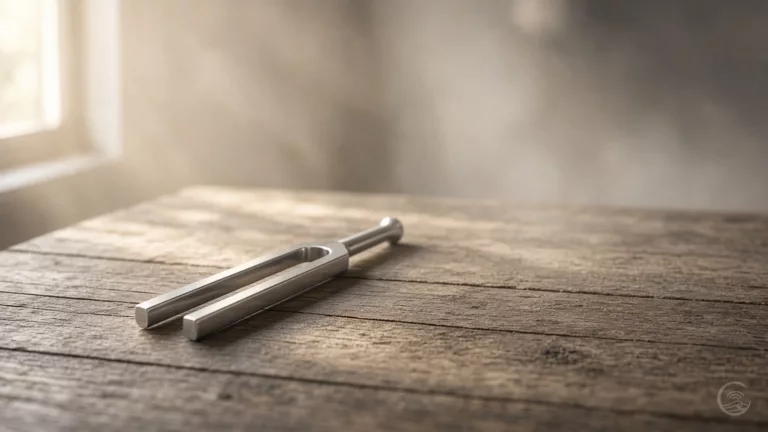
On the main Resonance Heritage Qi site, each of the six sounds is paired with a Solfeggio tone, described there as “an invitation to resonance, not a health claim.” That is the honest place for these tones. There they are used as musical tones, real pitches you can play and hear, although most of them do not match the notes of standard concert tuning (A = 440 Hz). Choosing pitches for tuning forks and music is like choosing a key: it shapes the mood and gives a session a consistent sound world. That is a legitimate artistic choice. It becomes a problem only when presented as evidence that a frequency acts on an organ or on DNA.
The same goes for qi. Saying that a Solfeggio tone “opens” an organ or moves qi is an artistic association or a metaphor at most; we found no controlled study testing such pairings. Here we keep the two apart: we use these tones because we like how they sound, not because research shows they do something special.
Try it gently (optional)
- Play a sustained tone or tuning fork at 528 Hz, then one at 523 Hz (close to a C in standard tuning).
- Ideally, ask someone to play them in random order without telling you which is which.
- Hum along softly, and notice your breath and how each one feels to you.
Whatever you prefer is personal taste, which is reason enough.
Enjoyed this article? Get my free practice guide to the Six Healing Sounds. Just sign up below, confirm your email, and it’s on its way.
Sources
- Encyclopaedia Britannica, n.d. Solmization. https://www.britannica.com/art/solmization (accessed 17 Oct 2026)
- Encyclopaedia Britannica, n.d. Guido d’Arezzo. https://www.britannica.com/biography/Guido-dArezzo-Italian-musician (accessed 17 Oct 2026)
- Lockhart E, 2025. Tuning Sounds in Italy, 1750–1885. Nineteenth-Century Music Review 22(3):344–360. https://doi.org/10.1017/S1479409824000375
- Horowitz LG, Puleo JS, 1999. Healing Codes for the Biological Apocalypse. Sandpoint, ID: Tetrahedron Publishing Group (edition consulted: © 1999, 2000, 2001; ISBN 978-0-923550-39-4). Cited only for its own account and claims, not as evidence.
- Le Guillou I (ed.), 2022. There is no evidence to support claim that Solfeggio frequencies remove toxins from the body. Science Feedback, 30 Sep 2022. https://science.feedback.org/review/no-evidence-support-claim-solfeggio-frequencies-remove-toxins-from-body/
- Akimoto K, Hu A, Yamaguchi T, Kobayashi H, 2018. Effect of 528 Hz music on the endocrine system and autonomic nervous system. Health 10(9):1159–1170. https://doi.org/10.4236/health.2018.109088
- Babayi T, Riazi GH, 2017. The effects of 528 Hz sound wave to reduce cell death in human astrocyte primary cell culture treated with ethanol. Journal of Addiction Research & Therapy 8(4):335. https://doi.org/10.4172/2155-6105.1000335
- Dos Santos AC, de Abreu MS, de Mello GP, et al., 2023. Solfeggio-frequency music exposure reverses cognitive and endocrine deficits evoked by a 24-h light exposure in adult zebrafish. Behavioural Brain Research 450:114461. https://doi.org/10.1016/j.bbr.2023.114461
- Bhoot A, Chowdhury AB, Shah H, Vaishnav B, 2025. Effect of OM chanting of 528Hz frequency on heart rate variability, psychological wellbeing, and quality of sleep in patients of hypertension: a randomised controlled trial. Annals of Neurosciences (online ahead of print). https://doi.org/10.1177/09727531251390261
- Ravikumar H, Sathyanarayanan S, 2026. Effects of a sound-based meditative intervention on anxiety, depression, salivary cortisol levels, and blood pressure: a randomized controlled trial. Cureus 18(9):e115693. https://doi.org/10.7759/cureus.115693
- Bozok ÜG, Özcan GB, Bayraktar B, Özen D, 2026. Acute music-frequency exposure modulates salivary stress and neurotrophic markers in young adults: a randomized controlled trial. Brain and Behavior 16(5):e71452. https://doi.org/10.1002/brb3.71452
Source quality note: The history rests on reference works, peer-reviewed musicology and the originating book itself. The health research is very thin: one nine-person pilot, one cell-culture study, one animal study and three recent trials, none of which reports comparing the same music at another frequency. None has been independently replicated.
Disclaimer
This article is for general education only. It is not medical advice and does not replace diagnosis or treatment by a doctor or other qualified health professional. Qigong and the Six Healing Sounds are traditional practices; we make no claims that they cure, treat or prevent any illness. If you have a health condition, are pregnant, or are unsure whether a practice suits you, please talk to your doctor first.