Glossary: the key words of Qigong, in plain English
Most entries describe traditional ideas from Qigong, Chinese medicine and Chinese thought. They are explained as tradition, not as facts about the body. Where research has looked at a topic, the entry points to the article that covers it.
Qigong comes with its own vocabulary, and the same word can mean different things in different books. This glossary gives a short, plain explanation of the words you’ll meet most often in this library, with the Chinese characters and the pinyin (the standard romanisation, with tone marks). Where we have a fuller article, the entry links to it. The terms are in alphabetical order; when you meet a word you don’t know in another article, you can look it up here.
The terms, A to Z
Acupuncture and acupressure points (穴位, xuéwèi; short 穴, xué, “hollow” or “cave”). In Chinese medicine, named points on the body, most of them on the channels (see Meridians), used in acupuncture and acupressure. Some Qigong teachers use point names to say where to place the attention. They are a traditional concept; what research has found when it looked for a physical basis of points and channels is summarised in “Ren, du and the microcosmic orbit: channels in medicine and inner alchemy”.
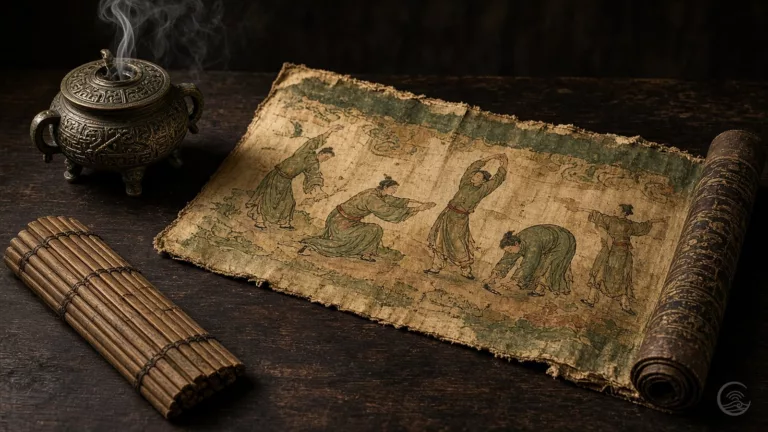
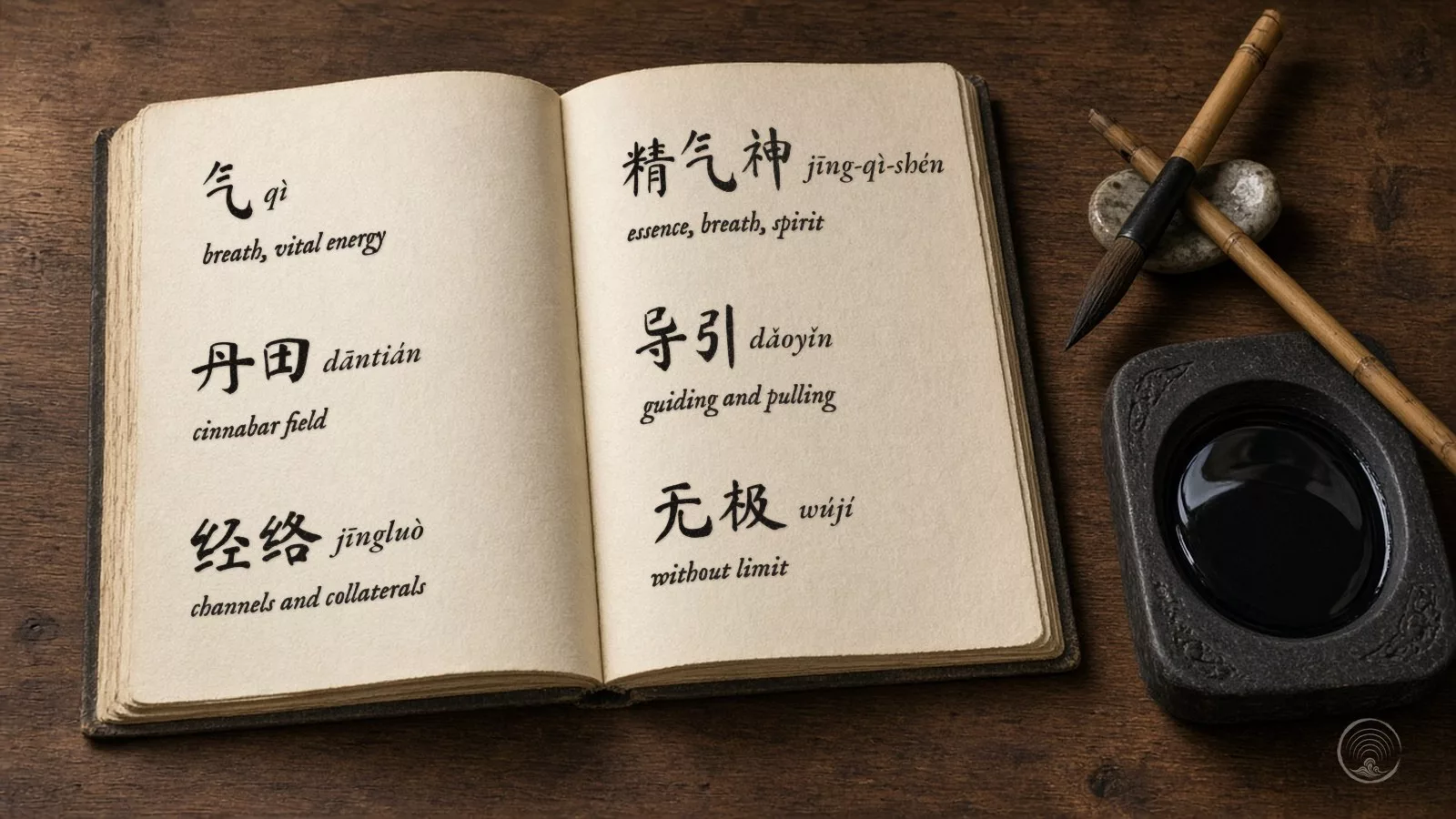
Daoyin (导引, dǎoyǐn, “guiding and pulling”). The old Chinese name for exercises that combine stretching, movement and breathing. A painted daoyin chart was sealed in a tomb at Mawangdui in 168 BCE, and much of modern Qigong grows from this tradition. See “Daoyin: from the Mawangdui chart to modern Qigong”.
Dantian (丹田, dāntián, “cinnabar field” or “elixir field”). In Daoist texts, three places in the body where gods, essence, qi and spirit are located: one in the lower belly, one in the chest or below the heart, and one inside the head. When a teacher just says “the dantian”, they usually mean the lower one. See “The three dantians: what the classical texts say”.
Duan (段位, duànwèi, “duan rank”). The grading system for practitioners of the Health Qigong forms in China, with grades from 1 to 9. It was introduced on a trial basis in 2014; the current rules apply from 2023. A Duan grade says something about a person’s level in particular Health Qigong forms, not about health. See “Learning Qigong today: how to choose a form, a teacher and trustworthy information”.
Evidence labels. The markers at the top of our articles that show how strong the evidence is for the main claim: 🟢 Well studied, 🟡 Early evidence, 🔵 Tradition only and 🟠 Speculative. 🟣 Lived experience marks what practitioners notice; it always sits beside an evidence label, never instead of one. 📜 Documented history marks well-documented historical facts. See “Our labels: how we mark the evidence”.
Five Phases, or Five Elements (五行, wǔxíng). Wood, fire, earth, metal and water: a traditional system that links seasons, colours, tones, organs and much else into five matching groups. Many English books call them the Five Elements; this library mostly says Five Phases, the term used in the WHO standard terminology, because the five are understood as phases of change rather than as substances. The correspondences are traditional theory, not tested findings. See “The Chinese five tones and the Five Phases”.
Health Qigong (健身气功, jiànshēn qìgōng). The Qigong forms standardised by China’s sport administration. The first four, issued in 2003, were Yi Jin Jing, Wu Qin Xi, Liu Zi Jue and Ba Duan Jin; more have followed. They are officially promoted as a sport, not as therapy. See “Health Qigong: how China’s standard forms were made”.
Jing, qi and shen (精气神, jīng-qì-shén). Essence, breath or vital energy, and spirit. Later Daoist texts call them the “three treasures” (三宝, sānbǎo), and inner alchemy describes refining one into the next. See “Jing, qi and shen: the three treasures of inner alchemy”.
Liu Zi Jue (六字诀, Liù Zì Jué, “six-character formula”). A breathing method in which each out-breath is shaped by one of six Chinese syllables; in the West it is often called the Six Healing Sounds. Its earliest surviving description is in a text traditionally attributed to the Daoist scholar Tao Hongjing (died 536), and a standard Health Qigong form appeared in 2003. My Six Healing Sounds practice is inspired by Liu Zi Jue; the form I share in my Immersions is my own. See “Liu Zi Jue: where the Six Healing Sounds come from”.
Meridians, or channels (经络, jīngluò, “channels and collaterals”: the main pathways and their branching network vessels). In Chinese medicine, the pathways along which qi is said to flow, linking the organs with the rest of the body. “Meridians” is the common English word; this library mostly says “channels”. They are a traditional concept; research that has looked for a physical basis has been inconclusive (see Acupuncture and acupressure points).
Microcosmic orbit, ren and du (小周天, xiǎozhōutiān, “lesser heavenly circuit”; 任脉, rènmài; 督脉, dūmài). The ren vessel runs up the front of the body and the du vessel up the back. In the medical classics they are two of eight “extraordinary vessels” and don’t form a loop; inner alchemy joined them into a circuit, known in English as the microcosmic orbit. See “Ren, du and the microcosmic orbit: channels in medicine and inner alchemy”.
Neidan (内丹, nèidān, “inner elixir”). The Daoist tradition of inner alchemy, which borrowed the language of laboratory alchemy and turned it into a path of inner cultivation. Neidan is not part of my Immersions. See “Neidan, inner alchemy: an introduction for practitioners”.
Neigong (内功, nèigōng, “internal work” or “internal skill”). First of all a martial artists’ term for skill trained inside the body. Today it is also used in connection with inner alchemy, and as a broad name for cultivating breath, posture and attention from the inside. See “What is neigong? An introduction”.
Neijia and waijia (内家, nèijiā, “internal school”; 外家, wàijiā, “external school”). The split between “internal” and “external” martial arts. It first appears in an epitaph written in 1669; in the 1920s Sun Lutang grouped Taijiquan (太极拳, Tàijíquán), xingyi and bagua as the internal arts. See “Internal and external: neijia, waijia and the epitaph of 1669”.
Qi (气, qì). Breath, air, and in Chinese thought the subtle “breath” of life, often translated as “vital energy”. It is a central concept of Chinese medicine and Qigong; on our label scale, ideas about qi are Tradition only. We know of no reliable evidence that a master can send qi into another person (see “What is Qigong? An introduction”).
Qigong (气功, qìgōng, “breath work” or “qi work”). A modern umbrella name for Chinese practices that combine posture or movement, breathing and attention. The practices are old; the word in its modern sense dates from the late 1940s and 1950s. See “What is Qigong? An introduction” and “The making of modern Qigong: Liu Guizhen, Tangshan and Beidaihe”.
Six Healing Sounds. The English name for Liu Zi Jue, and for my own music-assisted practice inspired by it. On this site the six sounds are written as English-friendly sustained sounds, listed here in the order I share them, with the organ each is paired with in traditional theory:
- SSSSS (呬, sī; read xì in dictionaries, sounded sī in Liu Zi Jue practice): lungs
- CHOOO (吹, chuī): kidneys
- SHHHH (嘘, xū): liver
- HAAAA (呵, hē): heart
- WHOOO (呼, hū): spleen
- HEEE (嘻, xī): triple burner
The standard 2003 Health Qigong form uses a different order: xū, hē, hū, sī, chuī, xī. The organ pairings are traditional theory, not anatomy, and they have changed over the centuries. See “Vowels and formants: the acoustics of the six sounds”.
Six Roots of Qigong. A way of sorting Qigong by where a practice comes from and what it was for. Many books divide Qigong into five roots: Medical, Martial, Daoist, Buddhist and Confucian. I add a sixth for the breath and movement traditions of China’s ethnic minorities; my teacher Bob Lowey calls this root Ethnic Qigong. The six are:
- Medical Qigong (医家气功, yījiā qìgōng): the daoyin exercises and their use in traditional medicine.
- Martial Qigong (武术气功, wǔshù qìgōng): training for fighting skill and relaxed, coordinated strength.
- Daoist Qigong (道家气功, dàojiā qìgōng): Daoist self-cultivation, including the three dantians and inner alchemy.
- Buddhist Qigong (佛家气功, fójiā qìgōng): meditation aimed at liberation, not health.
- Confucian Qigong (儒家气功, rújiā qìgōng): moral self-cultivation and quiet sitting.
- Ethnic Qigong: the breath and movement traditions of China’s ethnic minorities. Chinese lists often have “folk Qigong” (民间气功, mínjiān qìgōng) instead.
The roots overlap, and most practices belong to several. See “The Six Roots of Qigong”.
Song (松, sōng, “relaxed” or “loose”). The quality of being relaxed and released while staying upright, alert and rooted: relaxing without collapsing. In traditional characters, as in the older texts, it is written 鬆; in simplified characters it is the same as the character for “pine tree”. See “Song 松: relaxed and rooted, or how to relax without collapsing in the internal traditions”.
Taiji and Taijiquan (太极, tàijí, “supreme ultimate”; 太极拳, tàijíquán). Taiji is a concept of Chinese philosophy, often shown as the diagram of yin and yang. Taijiquan is the internal martial art named after it; in writing about the martial art it is often shortened to Taiji. In this glossary, “taiji” in the Wuji and Yin and yang entries means the philosophical concept. Research often studies Qigong and Taijiquan together; see “Qigong and Taijiquan: what systematic reviews say”.
TCM. Short for traditional Chinese medicine (中医, zhōngyī, literally “Chinese medicine”). In this library we usually just say “Chinese medicine”. Many Qigong ideas, such as qi, the channels, the organ systems and the Five Phases, come from it; we present them as traditional concepts, not as anatomy or proven physiology.
Triple burner (三焦, Sān Jiāo). One of the six “hollow” (fu) organs of Chinese medicine, divided into an upper, a middle and a lower burner. The classic Nànjīng (难经) says it “has a name but no form”. It is paired with HEEE, the sixth sound. See “The triple burner: ‘a name but no form’”.
Wuji (无极, wújí, “without limit”). In Chinese philosophy, the limitless, undivided state. Daoist cosmology and many Qigong traditions place it before taiji, the philosophical concept (see Taiji and Taijiquan): from wuji comes taiji, and from taiji yin and yang. Zhou Dunyi’s line 无极而太极 can be read that way, or, as Zhu Xi read it, as two names for one reality. In Qigong, wuji also names a quiet standing posture. In my Immersions we practise the sounds standing, in the wuji posture, for those who are able to stand comfortably. On standing practice in general, see “Stillness and posture: sitting and standing practice in the internal traditions”.
Yi (意, yì). Intention or attention: the mind turned towards something. Many internal practices say that the mind leads and the breath, the qi and the body follow. See “Guiding with the mind: yi, intention and visualisation in the internal traditions”.
Yin and yang (阴阳, yīnyáng). The paired opposites of Chinese thought, such as shade and sun, rest and movement, inside and outside. They are not fixed things but two sides of a changing balance; the taiji diagram shows them as two halves, waxing and waning. Chinese medicine uses the pair to describe the body in traditional terms.
Zhan zhuang (站桩, zhànzhuāng, “standing like a post”). Standing still in a fixed posture for a long time, best known through the boxer Wang Xiangzhai (1885–1963). It is usually placed in the Martial root of Qigong. See “Stillness and posture: sitting and standing practice in the internal traditions”.
Zouhuo rumo (走火入魔, zǒuhuǒ-rùmó, “fire going astray and entering the demonic”). The traditional phrase for inner practice going wrong. If something feels wrong in practice, stop and breathe normally, and if the feeling does not settle, talk to a doctor or another qualified health professional. See “Zouhuo rumo: when practice goes wrong” and “Who should be careful with breathing practices”.
Enjoyed this article? Get my free practice guide to the Six Healing Sounds. Just sign up below, confirm your email, and it’s on its way.
Disclaimer
This article is for general education only. It is not medical advice and does not replace diagnosis or treatment by a doctor or other qualified health professional. Qigong and the Six Healing Sounds are traditional practices; we make no claims that they cure, treat or prevent any illness. If you have a health condition, are pregnant, or are unsure whether a practice suits you, please talk to your doctor first.